Origin, access model, eligibility, and substitution are reviewer diagnostics, not judging criteria. Authentication requirements are not penalized.
02 The two blind reviews
Two independent reviewers scored this project blind, from a sanitized evidence packet.
Scores are shown separately so the reasoning stays inspectable. A withheld score means the reviewers differed by more than two points.
Reviewer A (round 1)
confidence 83%
Leverage
9 /10
Human clicks and agent calls mutate the same explicit expedition graph, room, mastery, and failure state; this shared state is central and difficult to reproduce robustly through generic UI driving.
Evidence cited
Story enumerates shared graph, active room, checkpoint, beliefs, strikes, branches, and mastery.
Four page tools directly mutate or inspect the same run.
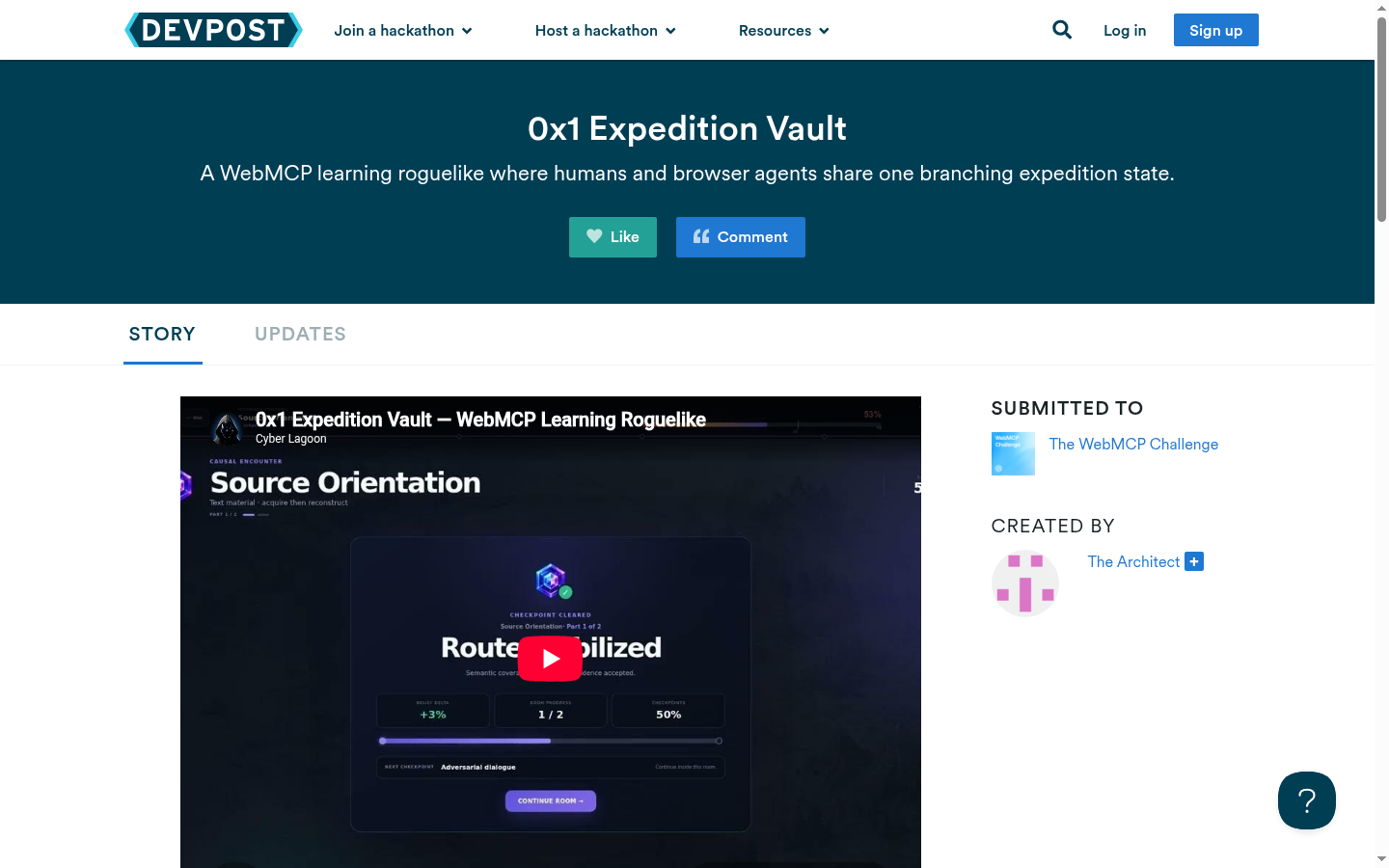
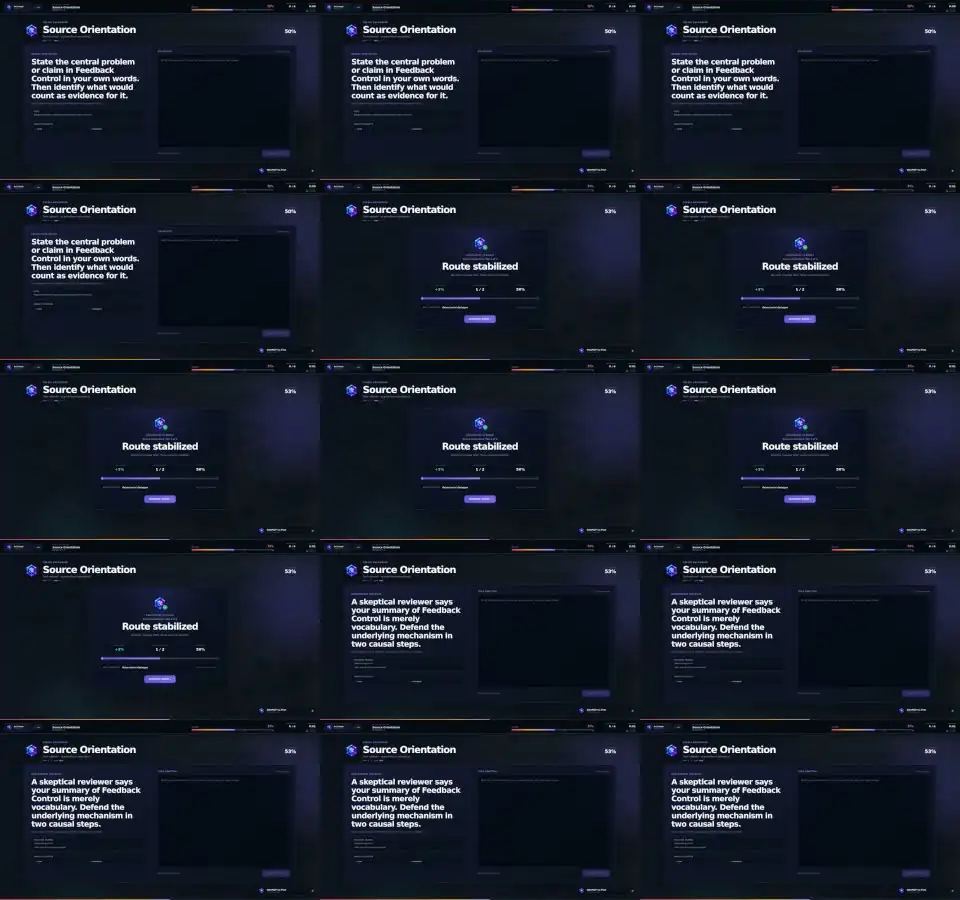
Frames show checkpoint-cleared, route-stabilized, progress, and continuation states.
Execution
8 /10
The screenshots show a coherent game/learning state machine with checkpoints, progress, and route transitions; the full source-to-boss journey is claimed but not entirely visible.
Evidence cited
Frames show Source Orientation tasks, progress around 50%, route stabilized, and next-checkpoint controls.
Devpost screenshot shows checkpoint-cleared and continue-room state.
Demo is marked alive and repository is public.
Impact
8 /10
Learners who want active, source-grounded study can benefit from a structured and motivating alternative to passive reading, with an identifiable educational audience.
Evidence cited
Supports lectures, articles, PDFs, notes, quizzes, and causal reasoning.
Learning tasks require explanation and defense, not only recall.
Creativity
9 /10
The combination of roguelike branching, shared agent/human state, and cognition checks is an ambitious and memorable learning interaction.
Evidence cited
Learning route choices have real run consequences.
Agent and learner can take turns in the same expedition.
Reviewer B (round 2)
confidence 71%
Leverage
8 /10
WebMCP directly exposes and mutates the same expedition graph and learning state the human sees; generic UI driving would be materially less reliable for branch and checkpoint state.
Evidence cited
Four page tools are named: ingest_learning_material, explore_module, submit_solution, inspect_progress.
Packet says human clicks and agent calls mutate the same graph, room, checkpoint, branches, mastery, strikes, and failure state.
Description explicitly contrasts shared state with DOM scraping.
Execution
7 /10
The packet presents a coherent, unusually complete learning/game loop and live demo, but there is no submitted video or transcript and visual evidence could not be confirmed.
Evidence cited
Live demo reported alive and public repository is present.
Description specifies ingestion, study, cognition checks, branching, failure/recovery, and final boss semantics.
No video submitted; gallery image count is zero.
Impact
8 /10
Learners who want active, source-grounded study get a credible motivation and feedback loop rather than passive recall.
Evidence cited
Supports YouTube, articles, PDFs, notes, and uploaded text.
Claims cognition checks, causal chains, adversarial defense, mastery, and recovery.
Creativity
8 /10
The combination of roguelike branching semantics and shared human-agent learning state is a memorable, ambitious interaction model.
Evidence cited
Learning is framed as runs with strikes, failure, recovery, skipped alternatives, and a systems boss.
Human and agent can take turns in one explicit expedition state.
03 Review highlights
Standouts across reviewers
WebMCP is structurally central rather than decorative.
Strong game-learning synthesis with shared state.
Shared branching learning state is central rather than cosmetic.
Strong game-mechanics fit for repeated study.
Red flags
Full content ingestion and final-boss flow are not shown in the supplied frames.
No transcript submitted.
No video or gallery frames submitted, limiting execution verification.
04 Evidence
What each artifact proves is labeled on the artifact itself. A Devpost page capture is packaging evidence, not proof the product runs;
video frames are evidence from the submitted demo, not live verification.
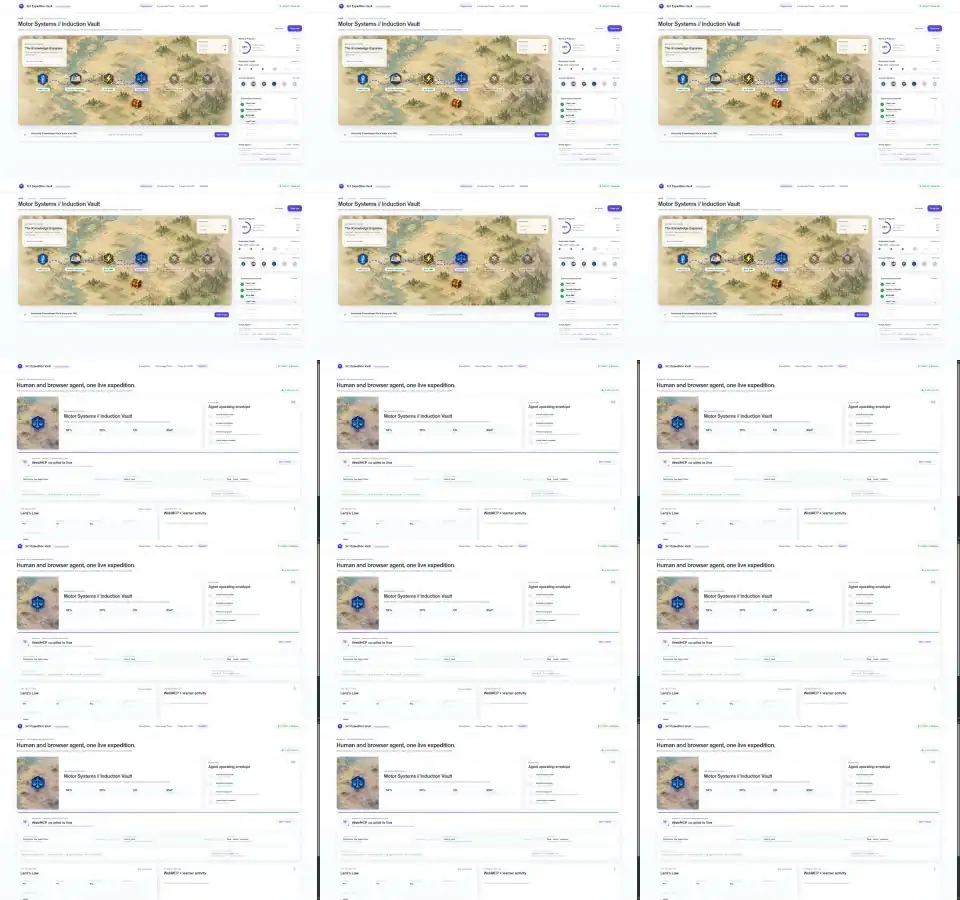
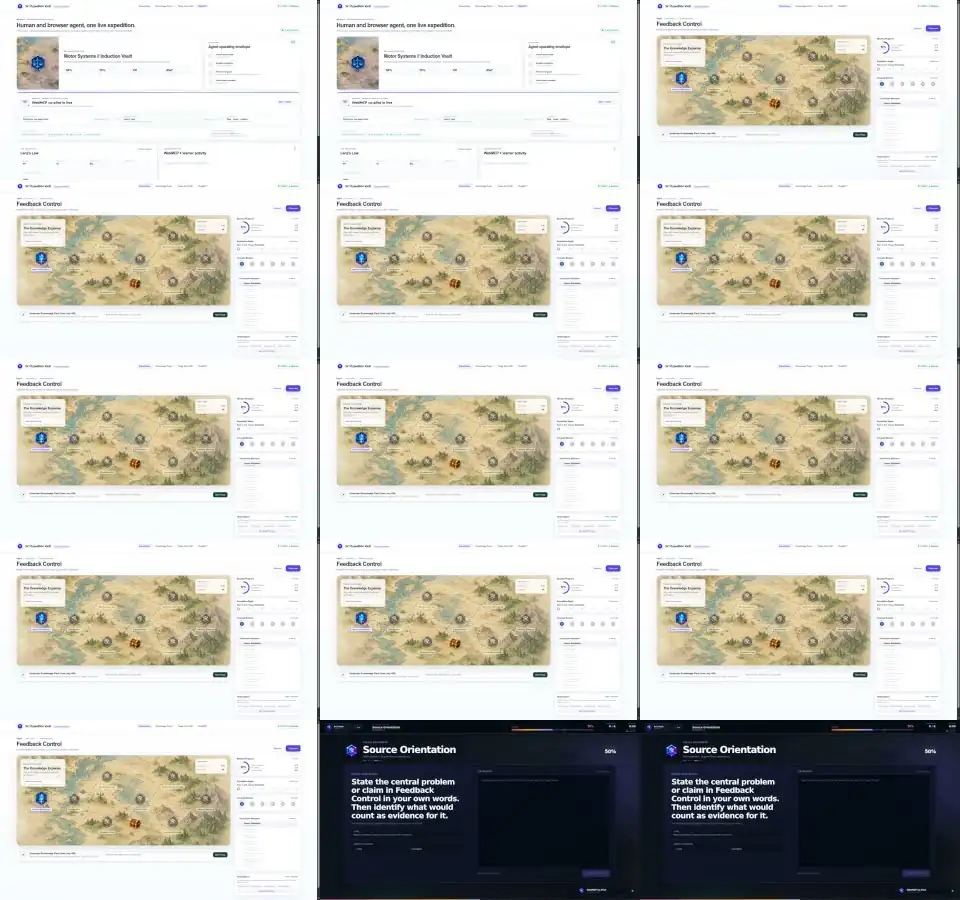
Contact sheets from the ?s video the team submitted. This is what reviewers were shown;
it demonstrates the product in motion but is not independent verification.
· watch the original
EX-V1 Sheet 1 of 3 · reported video evidenceEX-V2 Sheet 2 of 3 · reported video evidenceEX-V3 Sheet 3 of 3 · reported video evidence