Origin, access model, eligibility, and substitution are reviewer diagnostics, not judging criteria. Authentication requirements are not penalized.
02 The two blind reviews
Two independent reviewers scored this project blind, from a sanitized evidence packet.
Scores are shown separately so the reasoning stays inspectable. A withheld score means the reviewers differed by more than two points.
Reviewer A (round 1)
confidence 67%
Leverage
8 /10
Typed access to shared claims, evidence permissions, revision state, and compiler checks enables reliable constrained agent review that general UI automation could not safely reproduce.
Evidence cited
About specifies state-dependent tools and forbids agents from changing permissions, approving findings, or publishing.
Product is explicitly built around shared evidence and compiler state.
Execution
5 /10
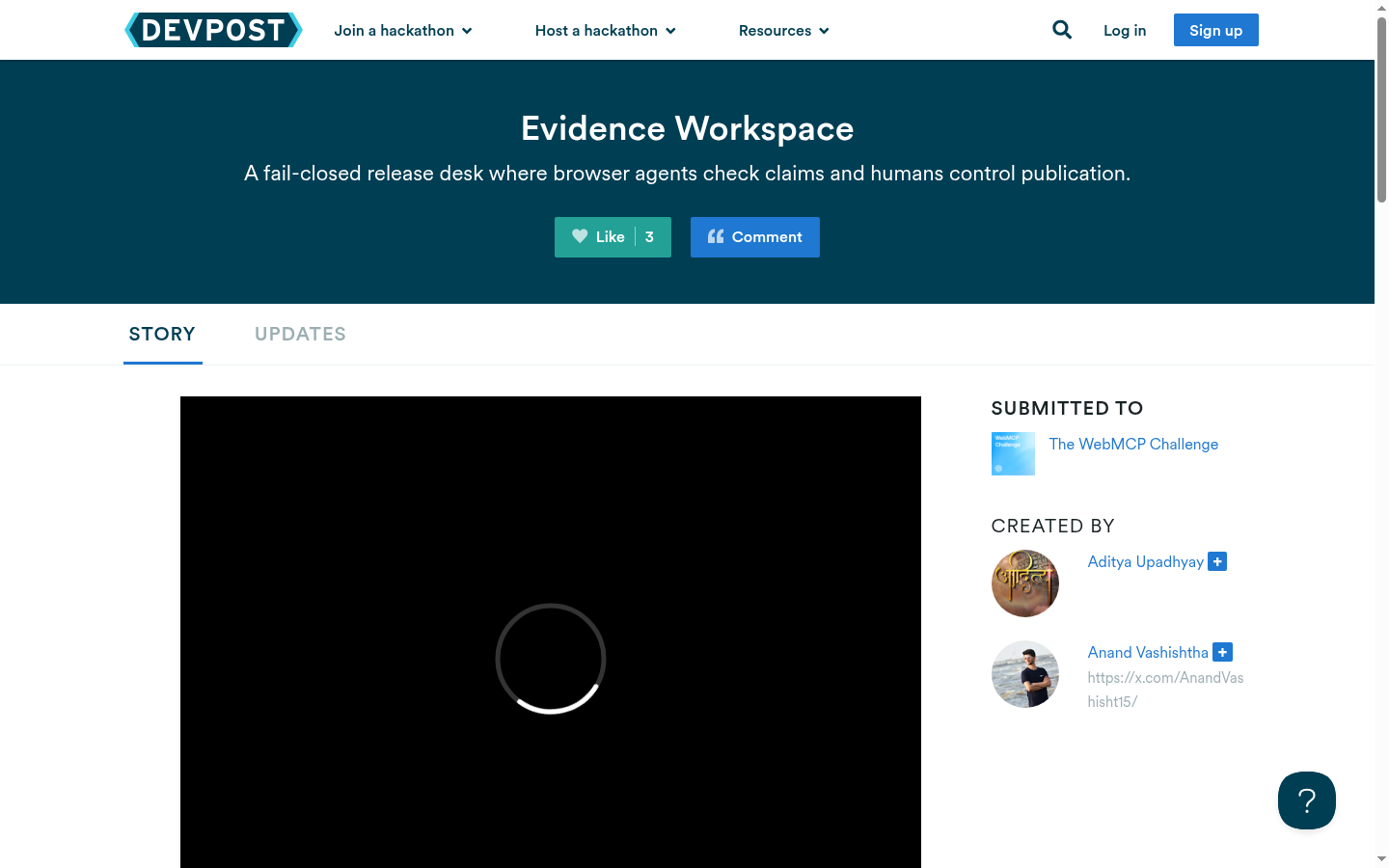
The described workflow is coherent, but the only submitted image shows a loading media panel and no actual product result; evidence caps execution.
Evidence cited
Devpost tagline gives a clear fail-closed release-desk scope.
Screenshot shows black media area with spinner and no visible report/check result.
Impact
8 /10
Editors and analysts have a concrete need to catch numerical/source mismatches before publication; human release control is credible value.
Evidence cited
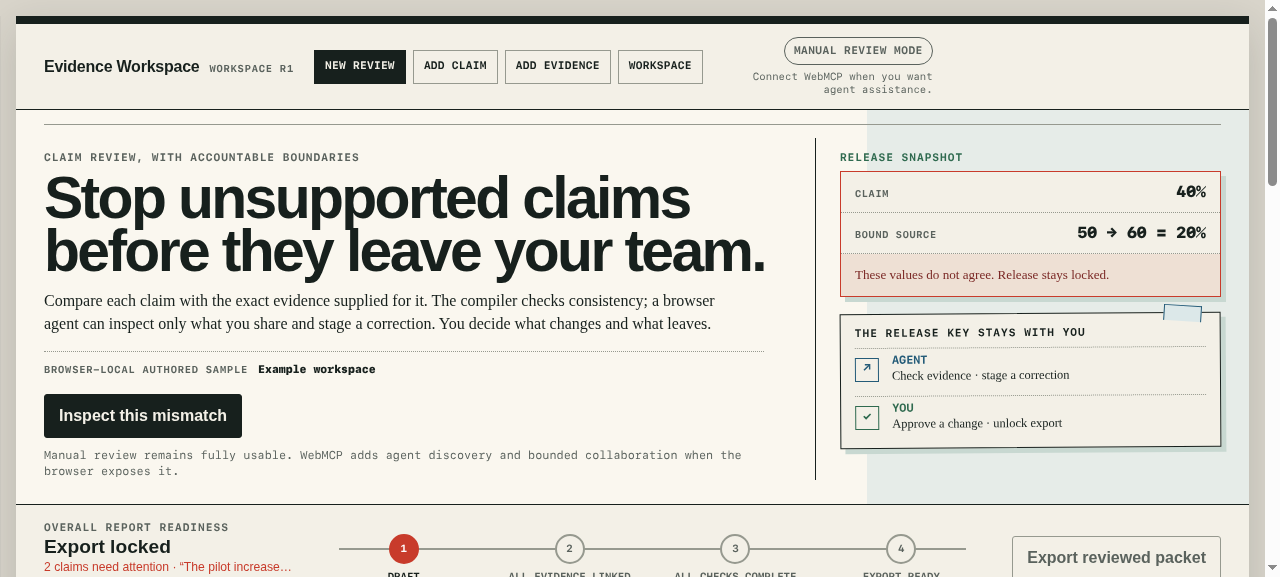
Specific 40% versus 50-to-60 (20%) mismatch example.
About describes claim, evidence, calculation, review history, and release decision in one workspace.
Creativity
8 /10
Fail-closed evidence compilation with agent proposals but human-controlled consequential actions is a strong, original interaction model.
Evidence cited
Agent can stage corrected wording but cannot approve or publish.
Compiler preview and evidence-sharing permissions are part of the model.
Reviewer B (round 2)
confidence 78%
Leverage
8 /10
Contextual, state-dependent tools expose only shared evidence and enforce a least-authority review workflow; a general UI agent would be less reliable and could not as cleanly preserve the fail-closed boundary.
Evidence cited
ABOUT text says tools use the same domain logic and inspect only shared evidence.
Agent can check, link, record findings, and stage wording but cannot approve, publish, or download.
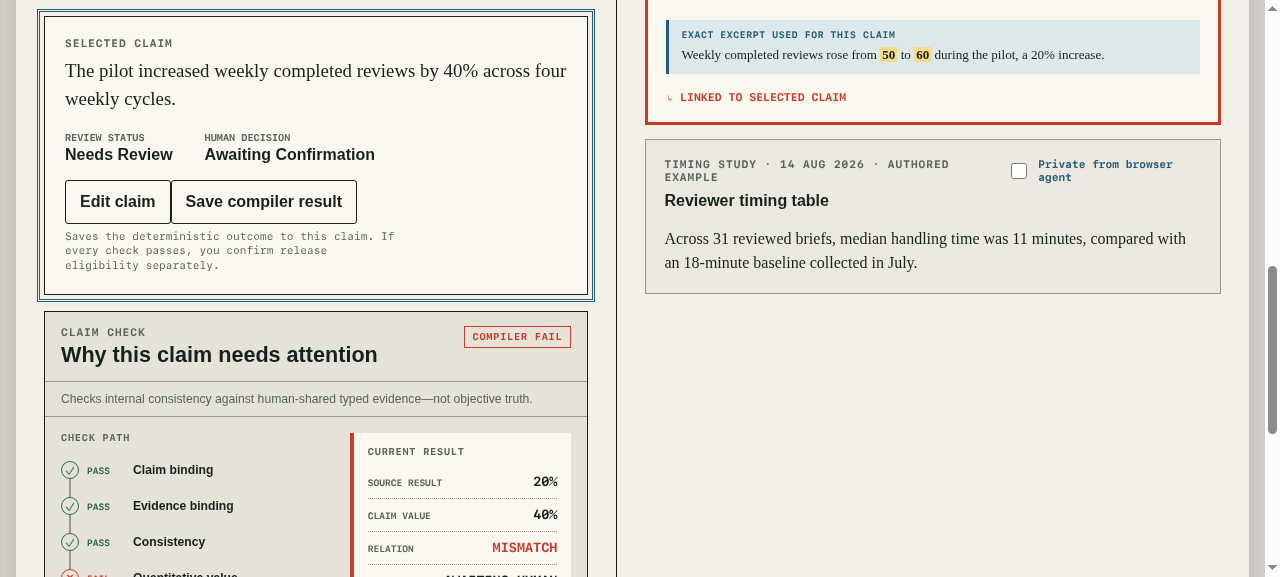
Compiler locks export while the 40% versus 20% mismatch is unresolved.
Execution
7 /10
The authored walkthrough gives a coherent central discrepancy and release gate, but no video or frames means end-to-end operation is claimed rather than observed.
Evidence cited
Public repository and alive demo reported.
ABOUT text specifies revisioned workspace, compiler preview, and locked export.
No submitted video.
Impact
8 /10
Editors and analysts have a real need to catch arithmetic/source mismatches before publication, and the human release boundary addresses accountability.
Evidence cited
Concrete 40% claim versus 50-to-60 source example.
Workflow preserves evidence, findings, and release decision.
Creativity
8 /10
The fail-closed compiler/release-desk framing is a thoughtful interaction model for agent-assisted evidence work, beyond generic report generation.
Evidence cited
Agent proposes and previews corrections without self-approval.
Evidence permissions and release authority are explicit product state.
03 Review highlights
Standouts across reviewers
Strong fail-closed publication and permission model.
Strong fail-closed publication boundary.
Concrete compiler discrepancy example.
Red flags
No gallery images and screenshot media did not load; runtime claims are unverified.
No video/frame evidence; most claims are textual.
04 Evidence
What each artifact proves is labeled on the artifact itself. A Devpost page capture is packaging evidence, not proof the product runs;
video frames are evidence from the submitted demo, not live verification.
Probe captures come from Stage 2 interactive testing of the live product by a reviewer.
EX-01 Devpost page capture · packaging evidence, not runtime proof
· sourceEX-02 Live probe at Stage 2 · observed product behavior, reviewer-drivenEX-03 Live probe after interaction · observed product behavior