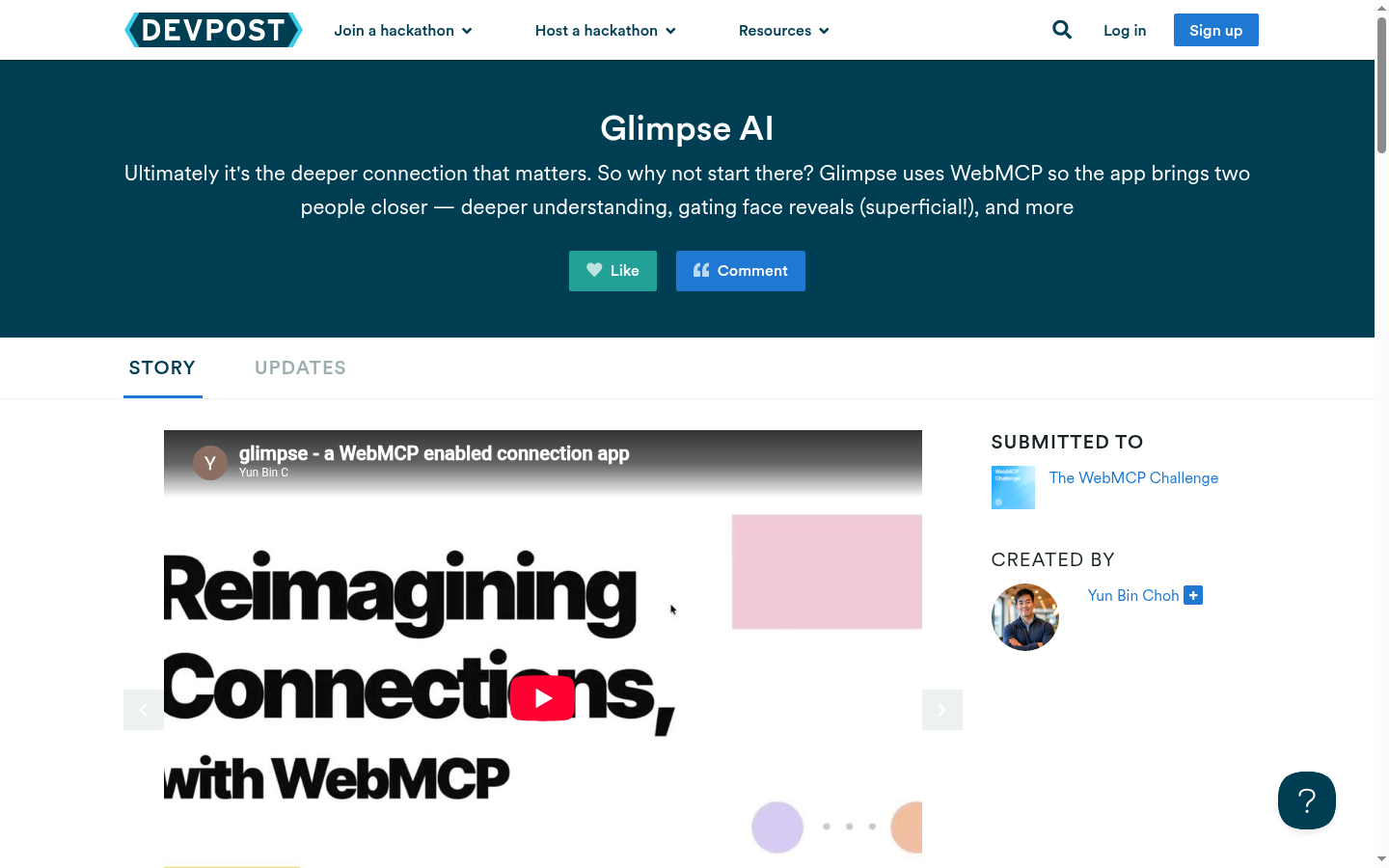
Ultimately it's the deeper connection that matters. So why not start there? Glimpse uses WebMCP so the app brings two people closer — deeper understanding, gating face reveals (superficial!), and more
Aggregate34
Leverage9
Execution8
Impact8
Creativity9
Each criterion 1–10, equally weighted; aggregate is their sum. Ranking is the pipeline's consolidated output.
Origin, access model, eligibility, and substitution are reviewer diagnostics, not judging criteria. Authentication requirements are not penalized.
02 The two blind reviews
Two independent reviewers scored this project blind, from a sanitized evidence packet.
Scores are shown separately so the reasoning stays inspectable. A withheld score means the reviewers differed by more than two points.
Reviewer A (round 1)
confidence 62%
Leverage
8 /10
The page holds private state from both participants and lets an agent provide contextual clues without leaking the other person's unrevealed answer, a boundary generic UI driving cannot reliably preserve.
Evidence cited
Both participants submit before the four answer blocks appear, so nobody goes first or is left on read.
Agent can pull clues and reflect on the interaction while being explicitly unable to see unrevealed answers or send unrequested messages.
Execution
6 /10
The interaction rules are unusually well specified, but no video transcript and no verified visual inspection cap claimed execution.
Evidence cited
About text details rounds, guesses, confidence levels, simultaneous reveal, and gated photos.
Packet reports alive demo, public repo, and six gallery images.
Impact
7 /10
There is a recognizable dating/conversation problem and the design offers a credible way to create more meaningful early interaction, though outcomes are inherently variable.
Evidence cited
Addresses superficial swiping and stalled opening chats.
Turns mistaken predictions into prompts for the next question rather than treating them as failure.
Creativity
9 /10
Mutual prediction, synchronized reveal, and staged face disclosure form a memorable interaction model that deliberately resists standard dating-app incentives.
Evidence cited
No face appears until both agree, and every round tests understanding rather than message generation.
Agent is positioned as a reflective third party, not a ghostwriter.
Reviewer B (round 2)
confidence 78%
Leverage
8 /10
WebMCP keeps both participants' state in the page and gives the agent bounded, privacy-aware access to staged clues and shared reveal mechanics unavailable from one-sided external observation.
Evidence cited
About text says the page is the only room holding both people and the agent cannot see the other answer prematurely.
Tools support clues, reflection, photo reveal gating, and shared state.
Execution
7 /10
The concept and described round mechanics are unusually coherent, but no video transcript and only gallery/frame evidence limit confidence in full interaction completion.
Evidence cited
Demo alive and public repo exists.
Gallery has multiple product states.
About text specifies simultaneous send, reveal, confidence levels, and agent boundaries.
Impact
8 /10
It addresses a real dating/conversation desire—deeper early connection—without outsourcing the conversation to AI, with a plausible playful audience value.
Evidence cited
Inspiration identifies superficial swiping and stalled chat as the problem.
Product mechanics create prompts and shared discovery rather than generated messages.
Creativity
9 /10
Blind mutual predictions, delayed face reveals, confidence calibration, and an agent that reflects rather than impersonates are highly distinctive interaction choices.
Evidence cited
Four-block simultaneous reveal mechanic.
Face reveal is gated by mutual progress; agent is intentionally bounded.
03 Review highlights
Standouts across reviewers
Distinctive anti-superficial dating interaction with strong agent boundaries.
No video/transcript; privacy and multi-user behavior need observation.
No submitted video.
Dating/privacy behavior would merit live testing beyond packet evidence.
04 Evidence
What each artifact proves is labeled on the artifact itself. A Devpost page capture is packaging evidence, not proof the product runs;
video frames are evidence from the submitted demo, not live verification.
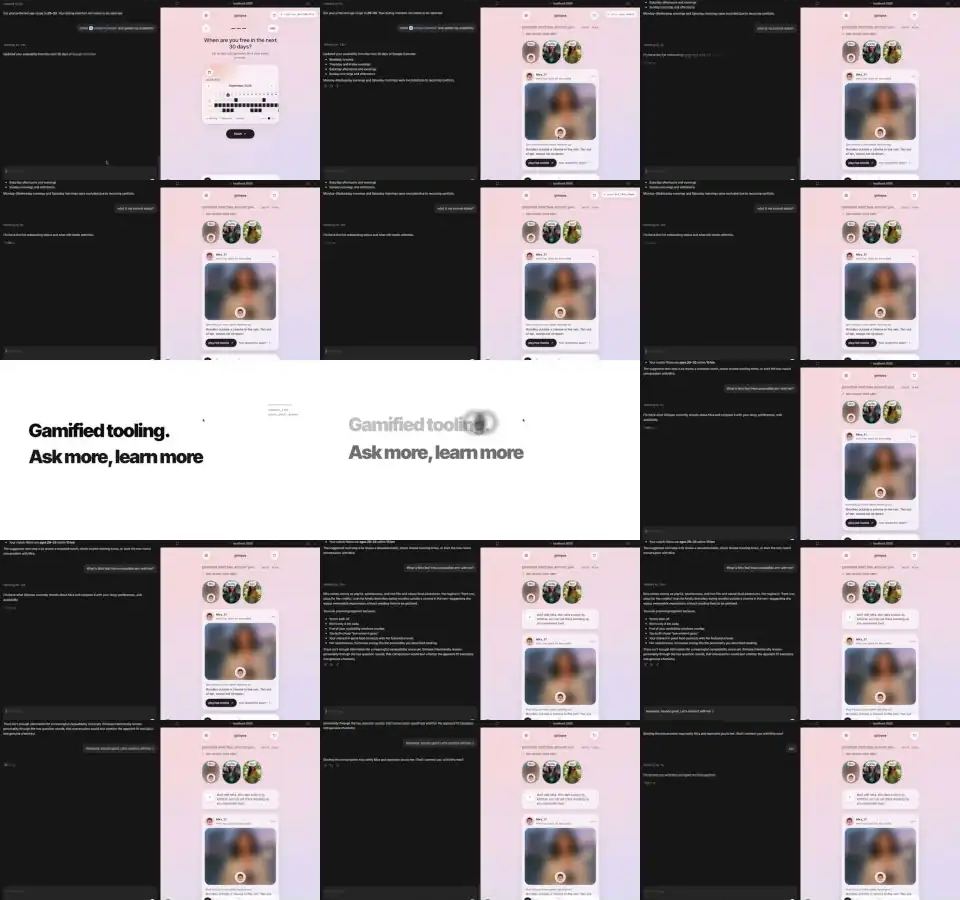
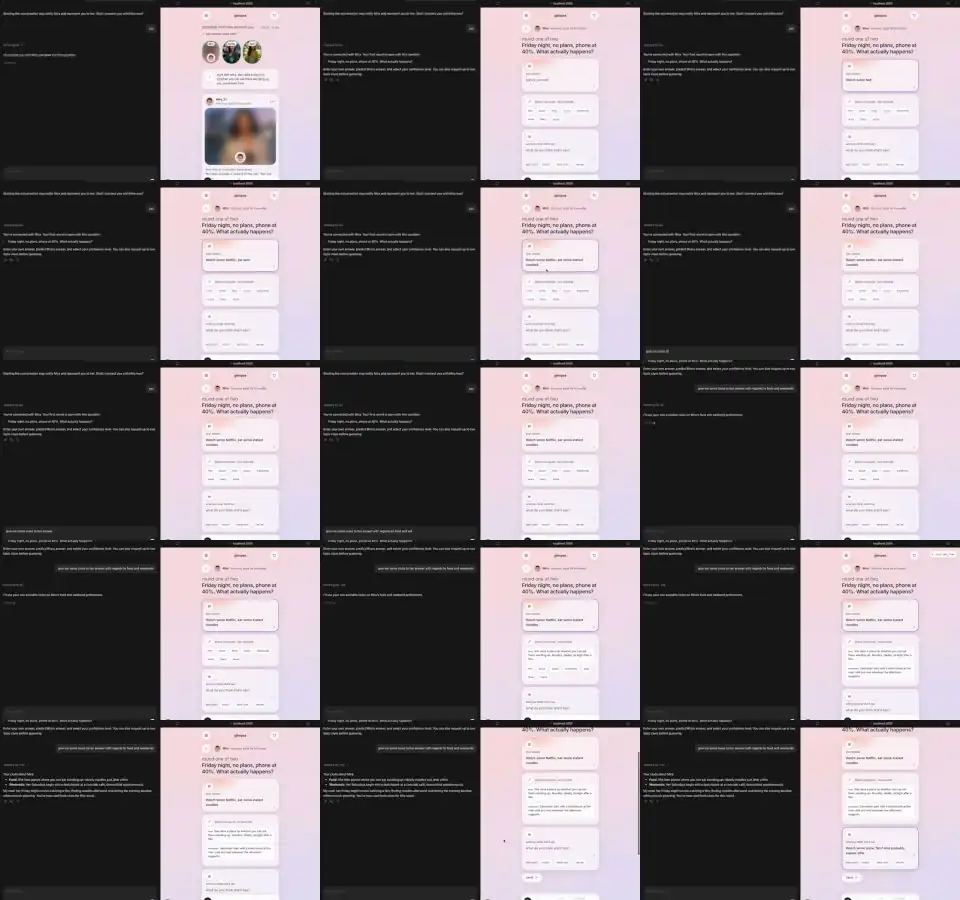
Contact sheets from the ?s video the team submitted. This is what reviewers were shown;
it demonstrates the product in motion but is not independent verification.
· watch the original
EX-V1 Sheet 1 of 3 · reported video evidenceEX-V2 Sheet 2 of 3 · reported video evidenceEX-V3 Sheet 3 of 3 · reported video evidence