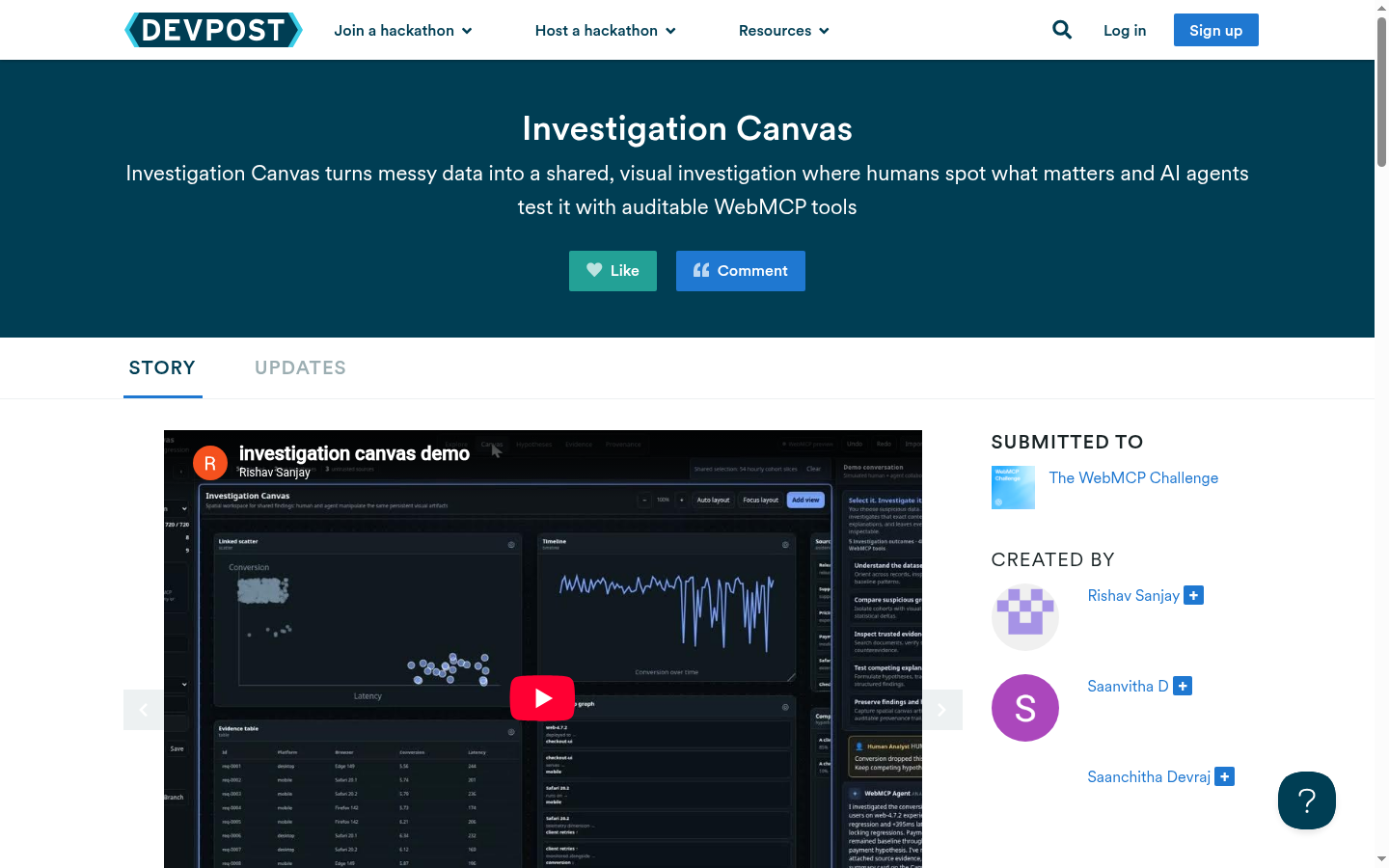
Investigation Canvas turns messy data into a shared, visual investigation where humans spot what matters and AI agents test it with auditable WebMCP tools
Aggregate36
Leverage10
Execution8
Impact9
Creativity9
Each criterion 1–10, equally weighted; aggregate is their sum. Ranking is the pipeline's consolidated output.
Origin, access model, eligibility, and substitution are reviewer diagnostics, not judging criteria. Authentication requirements are not penalized.
02 The two blind reviews
Two independent reviewers scored this project blind, from a sanitized evidence packet.
Scores are shown separately so the reasoning stays inspectable. A withheld score means the reviewers differed by more than two points.
Reviewer A (round 1)
confidence 75%
Leverage
9 /10
Structured access to a shared, evolving investigation state and auditable actions is central; scraping a canvas or exchanging summaries would lose precision, provenance, and collaboration state.
Evidence cited
About text describes 48 structured tools operating on the same workspace.
Every agent action changes the visible workspace and is auditable.
Three complete example investigations and a broad coherent interaction model are claimed, but the packet lacks video/transcript and public code.
Evidence cited
Description names three example investigations.
Four gallery images and live demo are reported.
Provenance trail and visible workspace changes are specified.
Impact
8 /10
Investigators, analysts, and researchers benefit from combining human pattern recognition with scalable agent search while retaining evidence visibility and challengeability.
Evidence cited
About text identifies shortcomings of chat-only and scrape-based analytics.
Capabilities directly support hypothesis testing and auditability.
Creativity
9 /10
The shared spatial canvas plus competing hypotheses, counterevidence, and provenance is a notably original interaction model for agent-assisted analysis.
Evidence cited
Human and agent manipulate the same visible investigation rather than exchanging summaries.
Branching and causal-link features pursue the concept deeply.
Reviewer B (round 2)
confidence 77%
Leverage
9 /10
Agents can operate directly on structured investigative state—records, cohorts, evidence, hypotheses, counterevidence, and provenance—while humans inspect and rearrange the same visible canvas.
Evidence cited
About text lists 48 tools spanning query, comparison, outliers, evidence, hypotheses, counterevidence, findings, causal links, views, and branches.
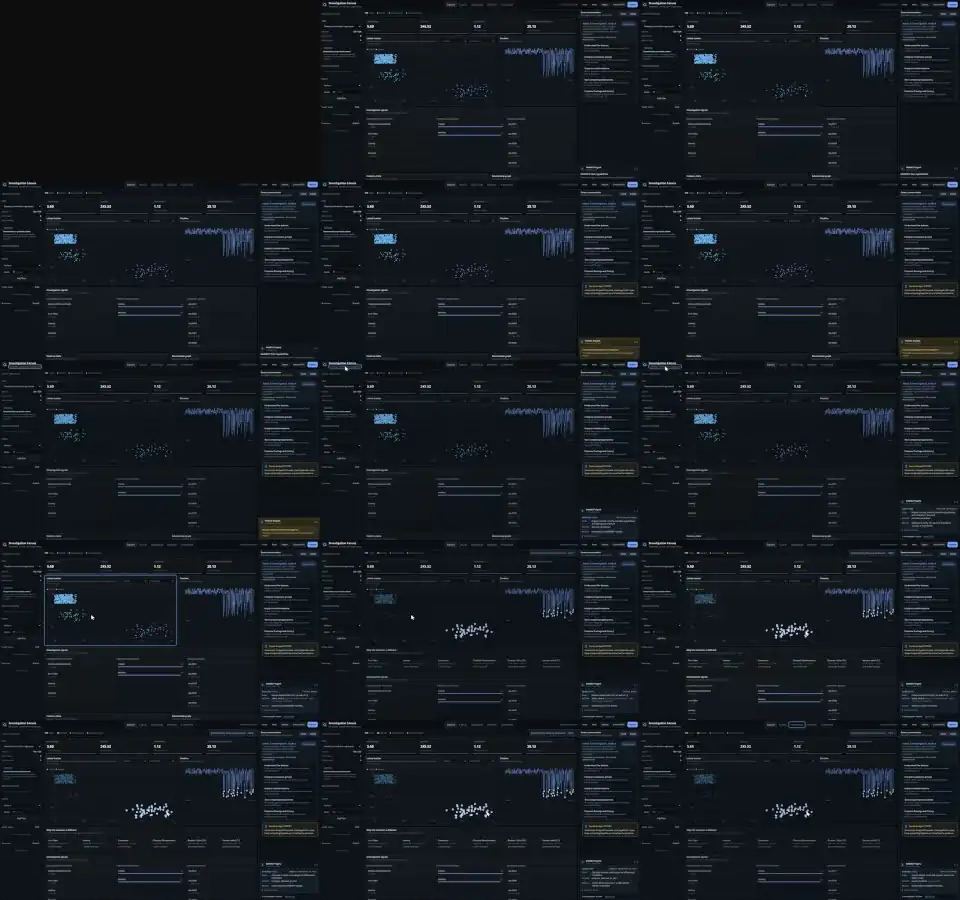
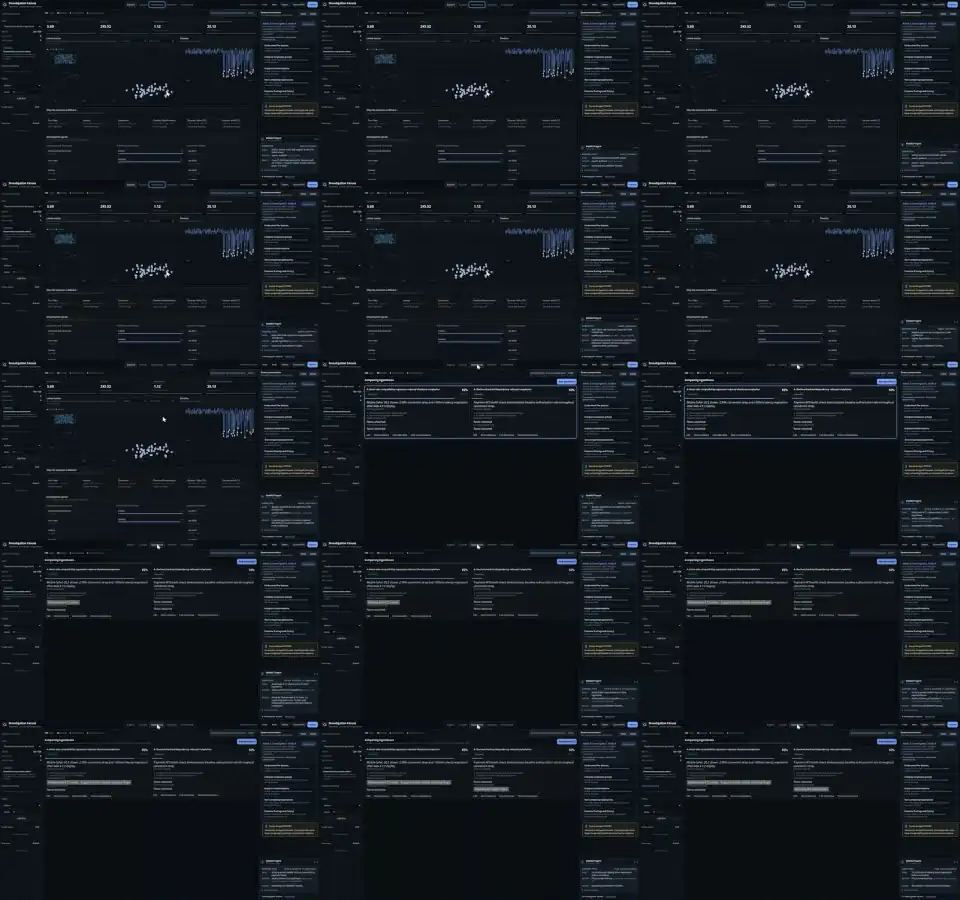
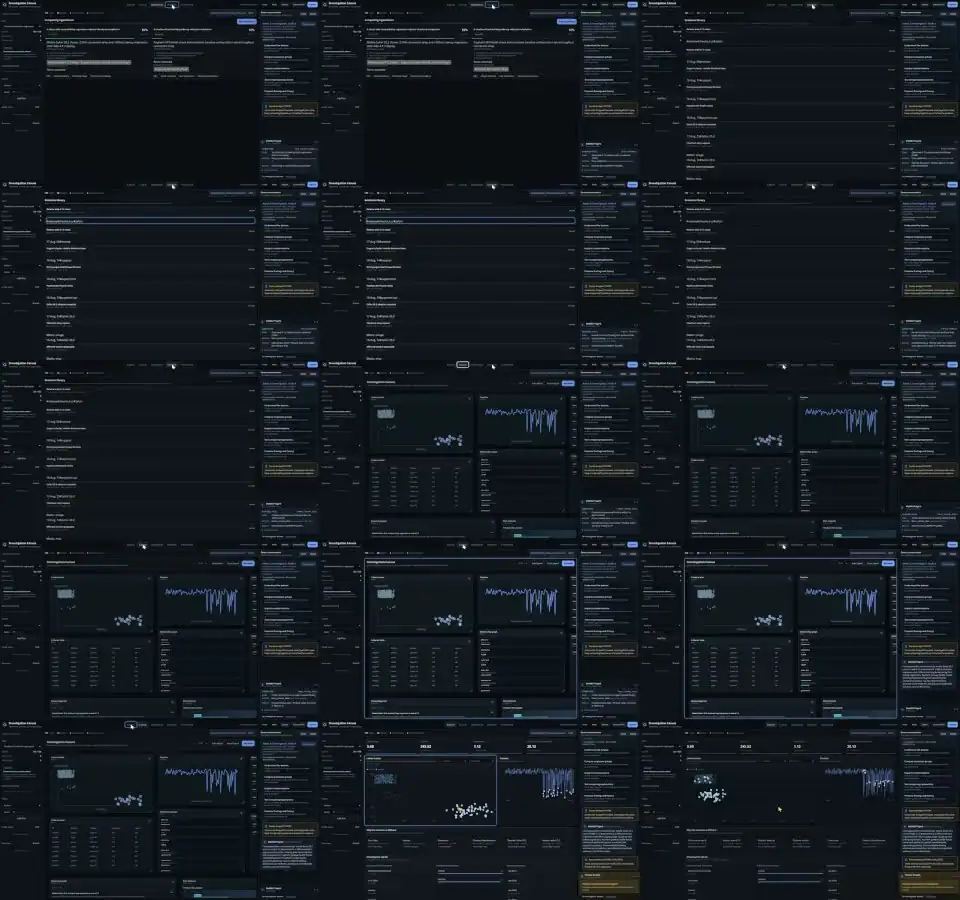
Frame sheets show map/data analysis panels, changing selected locations, charts, detailed research panes, and tool-like activity.
Every agent action is claimed to change visible workspace and provenance trail.
Execution
7 /10
The packet describes three complete example investigations and frames show map, narrative, chart, detail cards, and research panels, but fine-grained conclusions and provenance are not legible.
Evidence cited
About text names checkout regression, ML quality regression, and suspicious activity investigations.
Frames show populated geographic/data analysis workspace with result cards and supporting charts.
No video and no public repo reduce direct verification.
Impact
8 /10
Investigators, analysts, and data teams have a real need to combine human pattern recognition with scalable search, counterevidence, and auditability.
Evidence cited
Pitch articulates limits of chat-only and dashboard-only investigation workflows.
Visible interface combines map, narrative, chart, detailed results, and research pane.
Creativity
8 /10
A spatial, branchable investigation shared between human and agent, with explicit competing hypotheses and counterevidence, is a notably original interaction model.
Evidence cited
Canvas supports hypotheses, causal links, provenance, and branching rather than one-shot answers.
Human can challenge agent with contradictory examples.
03 Review highlights
Standouts across reviewers
Strong shared-state and provenance concept.
Unusually thoughtful counterevidence workflow.
Deep investigation model with counterevidence and branchable shared state.
Red flags
No video transcript or public repository.
Breadth of 48 tools is claimed without observed end-to-end use.
No public repo or video; exact tool invocation and provenance behavior remain partly inferred.
04 Evidence
What each artifact proves is labeled on the artifact itself. A Devpost page capture is packaging evidence, not proof the product runs;
video frames are evidence from the submitted demo, not live verification.
Contact sheets from the ?s video the team submitted. This is what reviewers were shown;
it demonstrates the product in motion but is not independent verification.
· watch the original
EX-V1 Sheet 1 of 3 · reported video evidenceEX-V2 Sheet 2 of 3 · reported video evidenceEX-V3 Sheet 3 of 3 · reported video evidence