Origin, access model, eligibility, and substitution are reviewer diagnostics, not judging criteria. Authentication requirements are not penalized.
02 The two blind reviews
Two independent reviewers scored this project blind, from a sanitized evidence packet.
Scores are shown separately so the reasoning stays inspectable. A withheld score means the reviewers differed by more than two points.
Reviewer A (round 1)
confidence 92%
Leverage
10 /10
WebMCP is the product's motion stack: invalid actions are absent rather than merely rejected, and shared live state changes the available agent surface. A general UI-driving agent cannot replicate this reliability and precision comparably well.
Evidence cited
Transcript says tools are rendered from document.modelContext.getTools().
A second-degree amendment removes move_to_amend_the_amendment from the tool set.
Quorum change collapses 17 tools to 9 without changing phase.
explain_path_to performs an AND-OR search over adversarial vote outcomes.
Execution
9 /10
The packet gives unusually coherent end-to-end evidence across motion modeling, dynamic tool registration, search, abort behavior, and injection-safe minute drafting.
Evidence cited
158-second video with transcript describing multiple completed workflows.
Search proved complete to depth 6 over 399 nodes.
Injection is transcribed as data while the motion remains pending.
Public repository and live demo are reported.
Impact
8 /10
Small boards, HOAs, student unions, and nonprofits have a real procedural problem and often lack a parliamentarian; the demonstrated clerk workflow offers credible value even for a niche audience.
Evidence cited
Transcript identifies HOA meetings and lack of parliamentarians.
About text names boards and nonprofits as intended contexts.
Creativity
10 /10
Making the declarative WebMCP tool surface itself equal the set of procedurally legal moves, combined with AND-OR planning and adversarial-content handling, is unusually original and deeply pursued.
Evidence cited
Out-of-order actions do not exist to be called.
Tool registration/removal is driven by the same meeting rules.
The product demonstrates contingent planning and prompt-injection contradiction.
Reviewer B (round 2)
confidence 92%
Leverage
10 /10
WebMCP is the product's central mechanism: the available action surface itself is the legal motion state, so an agent cannot call an out-of-order motion rather than merely receiving a refusal. Shared live state and dynamic registration materially change reliability and safety beyond UI automation.
Evidence cited
Transcript says getTools() renders the current in-order motion set and an out-of-order motion is absent, not refused.
Changing members present from 7 to 4 collapses the tool surface from 17 to 9 without changing phase.
explain_path_to performs an AND-OR search over uncontrolled vote outcomes and returns a proved plan.
Execution
9 /10
The packet gives unusually coherent end-to-end evidence of the motion stack, quorum changes, planning, and injection-resistant minutes, with a live demo and video. Small details are still claimed through transcript rather than independently inspectable source here.
Evidence cited
158-second video is supplied with a transcript covering multiple complete states.
Transcript reports 399-node depth-6 planning, dynamic tool removal, and minutes that preserve an injected string as data while leaving the motion pending.
Demo is marked alive and the project has a public repository.
Impact
8 /10
Small boards, associations, student unions, and nonprofits have a concrete procedural problem and often lack parliamentarians; the product directly reduces procedural mistakes and makes state legible.
Evidence cited
Packet identifies homeowners' associations, co-op boards, student unions, and small nonprofits as intended users.
The demonstrated workflow handles amendments, quorum, voting contingencies, and minutes rather than generic meeting notes.
Creativity
10 /10
It turns a formal rule system into a capability surface: legal procedure becomes the agent's available vocabulary, combined with contingent planning and prompt-injection-resistant recordkeeping.
Evidence cited
The core concept is that an out-of-order motion does not exist to be called.
The motion stack, dynamic tool registration, AND-OR outcome planning, and contradictory minute record form a distinctive interaction model.
03 Review highlights
Standouts across reviewers
WebMCP tool availability is used as a formal legality boundary, not just an integration layer.
Strong adversarial and abort-signal demonstrations.
Capability surface is itself a semantic model of parliamentary legality.
Strong safety treatment of quorum changes and untrusted motion text.
04 Evidence
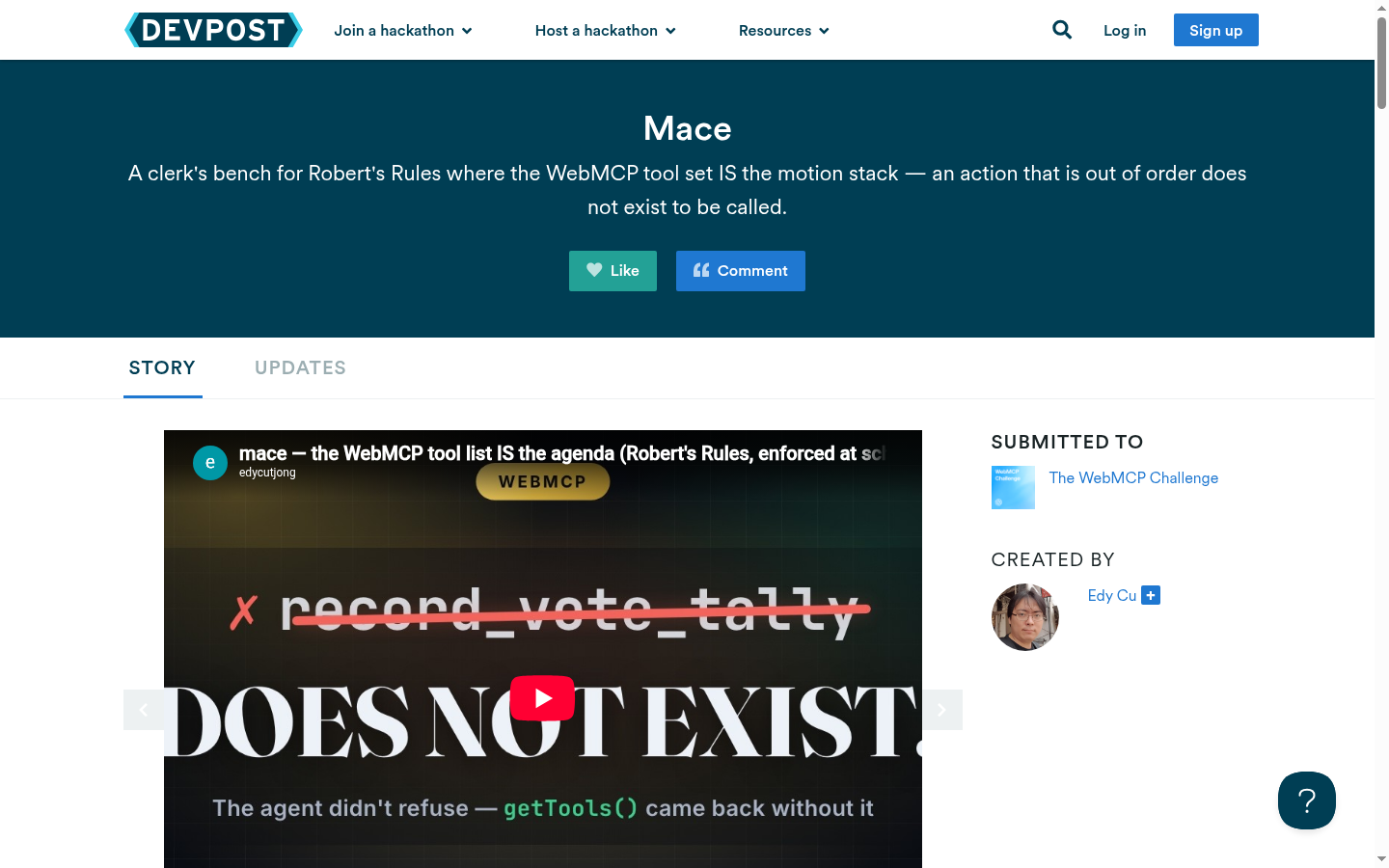
What each artifact proves is labeled on the artifact itself. A Devpost page capture is packaging evidence, not proof the product runs;
video frames are evidence from the submitted demo, not live verification.
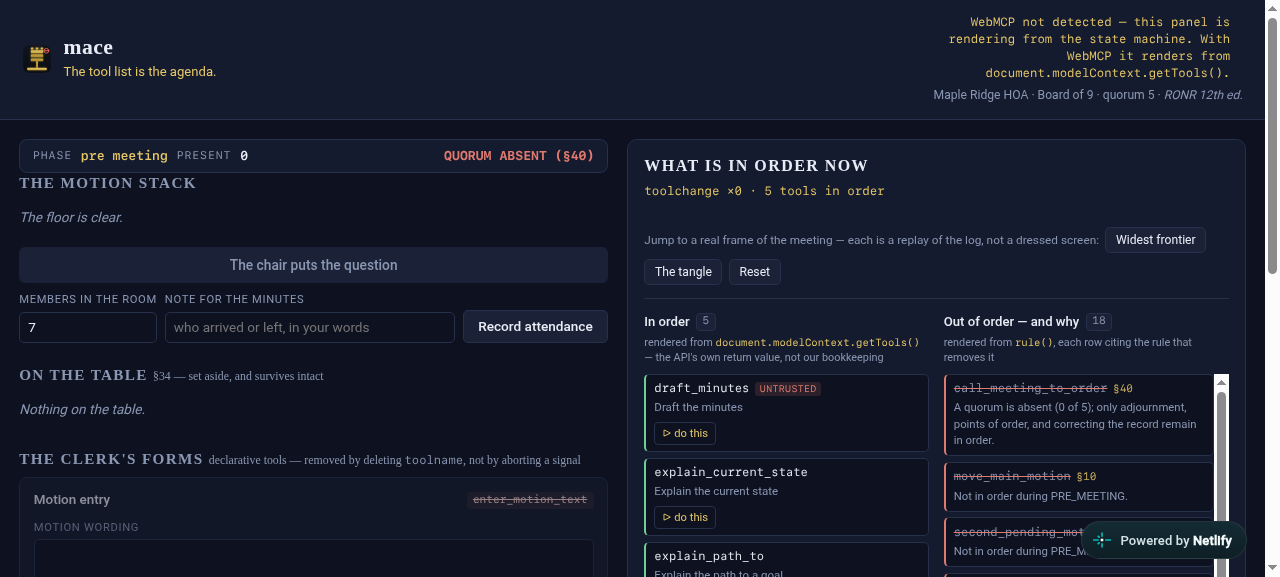
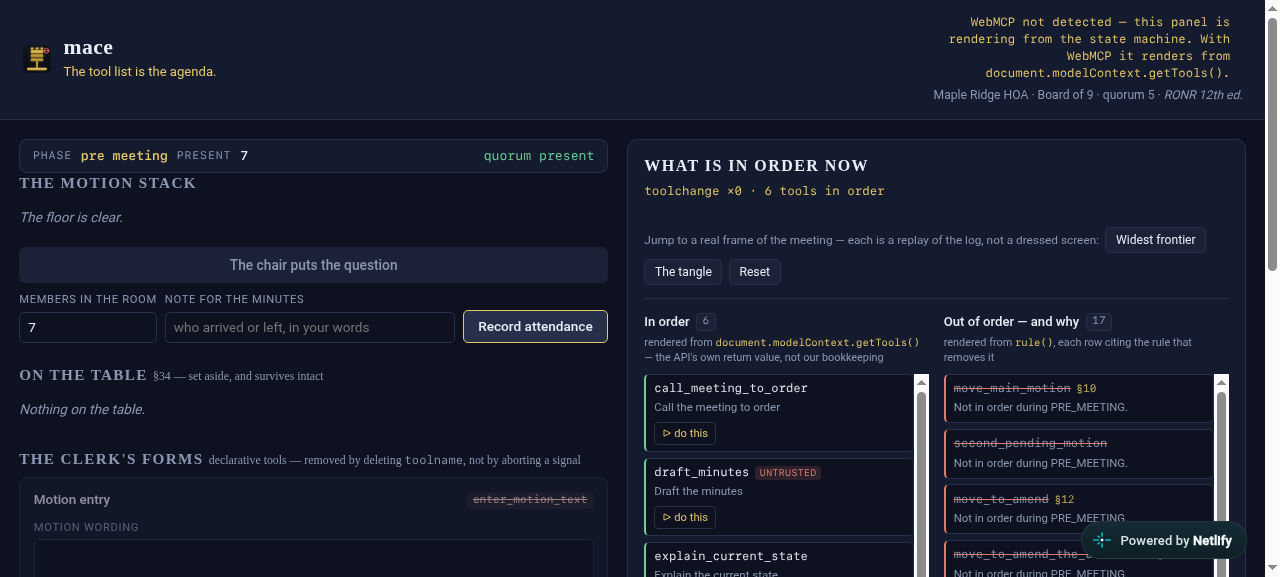
Probe captures come from Stage 2 interactive testing of the live product by a reviewer.
EX-01 Devpost page capture · packaging evidence, not runtime proof
· sourceEX-02 Live probe at Stage 2 · observed product behavior, reviewer-drivenEX-03 Live probe after interaction · observed product behavior
EX-V Submitted demo video — “mace — the WebMCP tool list IS the agenda (Robert's Rules, enforced at schema level)”
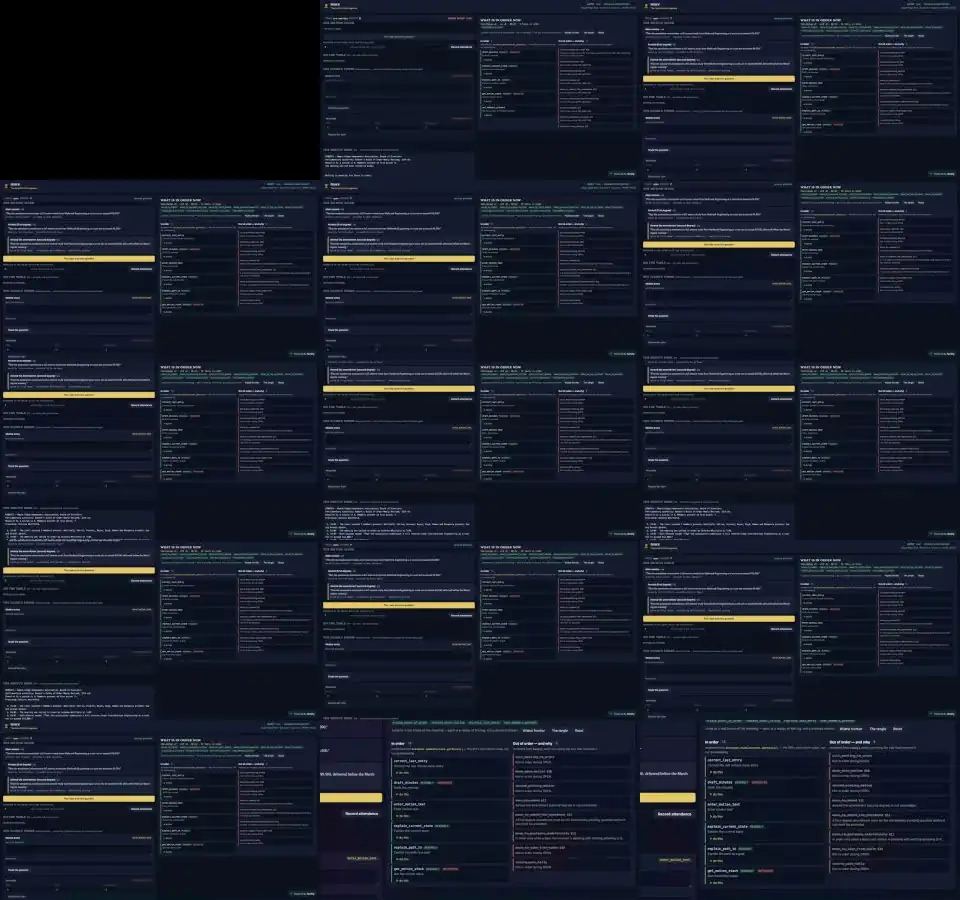
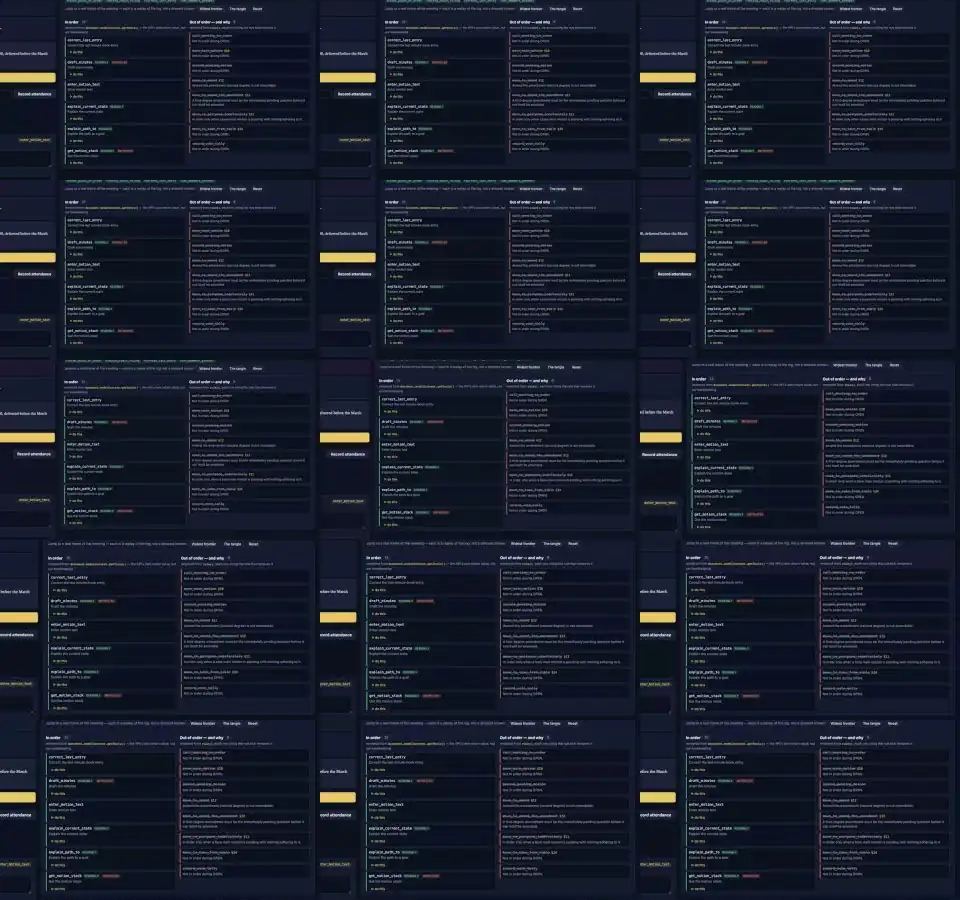
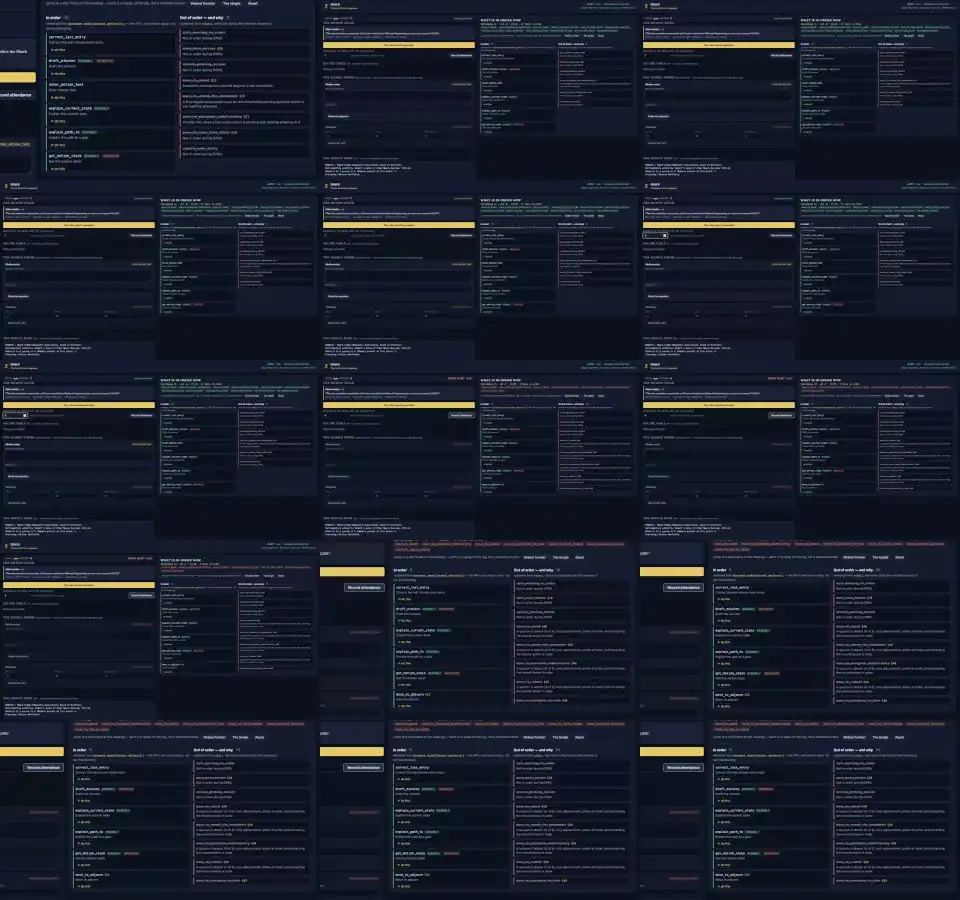
Contact sheets from the 158s video the team submitted. This is what reviewers were shown;
it demonstrates the product in motion but is not independent verification.
· watch the original
EX-V1 Sheet 1 of 3 · reported video evidenceEX-V2 Sheet 2 of 3 · reported video evidenceEX-V3 Sheet 3 of 3 · reported video evidence