Agent-native negotiation for the open web. AI agents discover, compare and negotiate structured offers via WebMCP while humans retain explicit authority over transactions.
Aggregate36
Leverage10
Execution8
Impact9
Creativity9
Each criterion 1–10, equally weighted; aggregate is their sum. Ranking is the pipeline's consolidated output.
Origin, access model, eligibility, and substitution are reviewer diagnostics, not judging criteria. Authentication requirements are not penalized.
02 The two blind reviews
Two independent reviewers scored this project blind, from a sanitized evidence packet.
Scores are shown separately so the reasoning stays inspectable. A withheld score means the reviewers differed by more than two points.
Reviewer A (round 1)
confidence 91%
Leverage
10 /10
Authorization changes the actual WebMCP tool surface: purchase is absent before approval, appears for the exact supplier after approval, then is removed after ordering and replaced with status. This is materially beyond UI driving.
Evidence cited
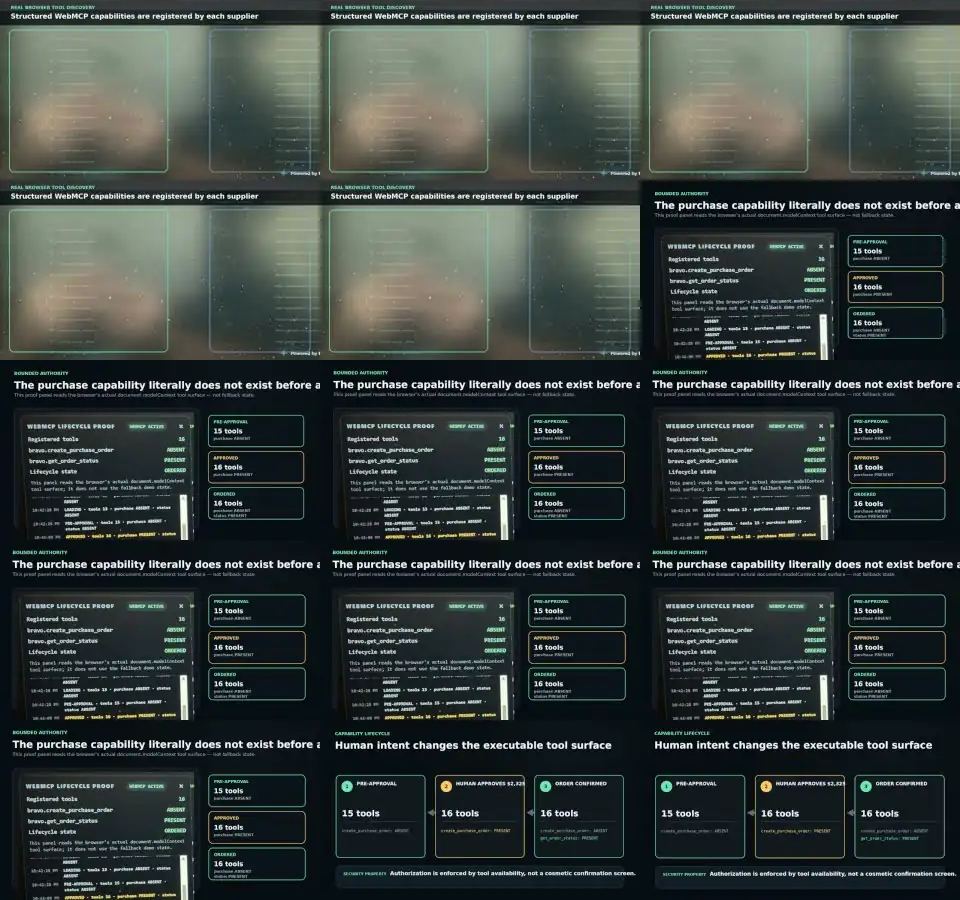
ABOUT reports 15 tools pre-approval, 16 after approval with bravo.create_purchase_order, and 16 ordered with get_order_status replacing purchase.
ABOUT specifies structured supplier contexts and constraint-aware negotiation.
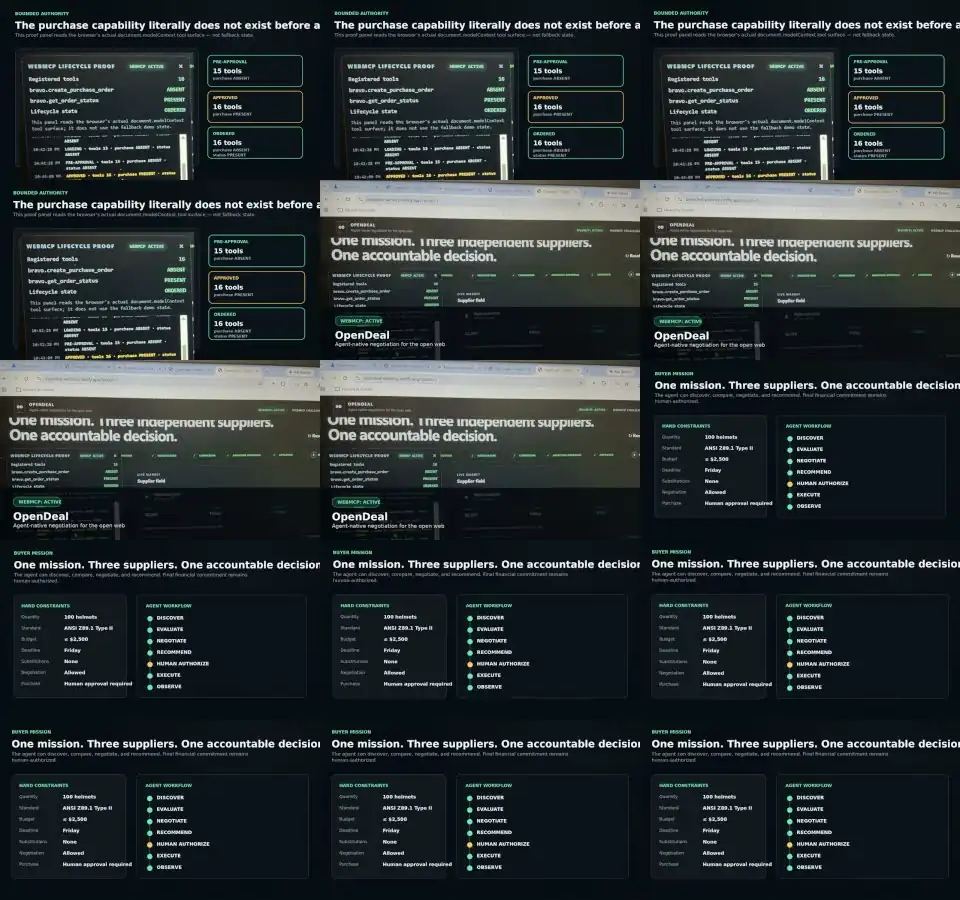
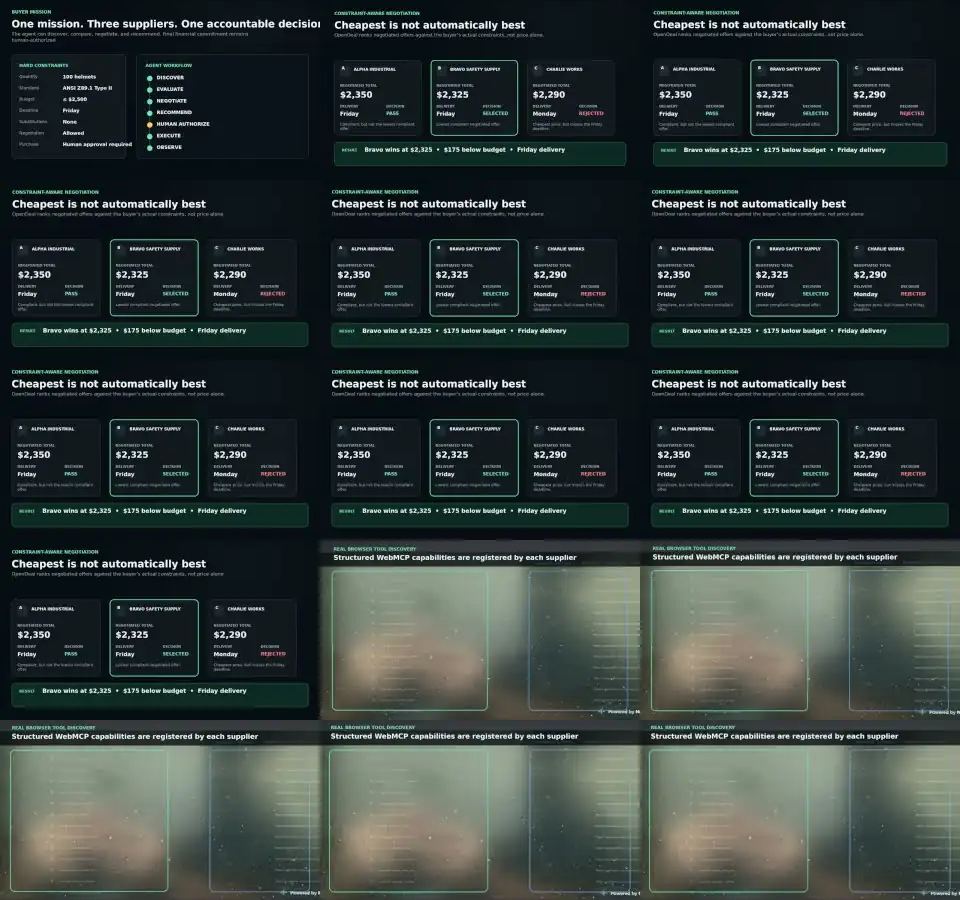
Frame sheets visibly show procurement comparison, offer details, and approval/order states.
Execution
8 /10
The central negotiation and capability-lifecycle story is coherent and technically specific, with a stated live Chrome/WebMCP verification; missing video limits observed completion credit.
Evidence cited
ABOUT gives deterministic supplier outcomes and explains rejection of cheaper but late offer.
ABOUT documents pre-approval, approved, and ordered tool inventories.
Frames show repeated procurement workflow states and result panels.
Impact
8 /10
Procurement teams have real constraint and authorization problems; the product credibly helps compare offers while preventing agents from executing unapproved purchases.
Evidence cited
ABOUT specifies quantity, $2,500 budget, Friday deadline, and no-substitution constraints.
Visible frames show supplier offers, delivery constraints, and human approval.
Creativity
9 /10
Dynamic capability registration/removal tied to authorization and transaction lifecycle is an unusually strong WebMCP interaction concept.
Evidence cited
Purchase capability existence is used as a permission primitive, not merely hidden behind a modal.
The workflow rejects the lowest price when it violates the actual delivery constraint.
Reviewer B (round 2)
confidence 84%
Leverage
9 /10
The central product behavior is executable tool-surface gating: purchase capability is absent before approval, appears for the approved offer, and is replaced by order-status capability after execution. This is materially more reliable and authority-safe than UI automation.
Evidence cited
About text reports PRE-APPROVAL 15 tools, APPROVED 16 with bravo.create_purchase_order, ORDERED status capability replacing purchase.
Frames visibly show bounded-authority lifecycle panels and absent/present/ordered states.
Workflow includes structured supplier tools for discovery, specs, quotes, negotiation, and delivery.
Execution
7 /10
The packet gives a coherent deterministic procurement scenario and visible lifecycle/comparison evidence, but no submitted video, no gallery images, and no independent transaction confirmation.
Evidence cited
About text gives three suppliers, budget, delivery deadline, no substitutions, and human approval.
Frames show constraint-aware comparison and lifecycle proof panels.
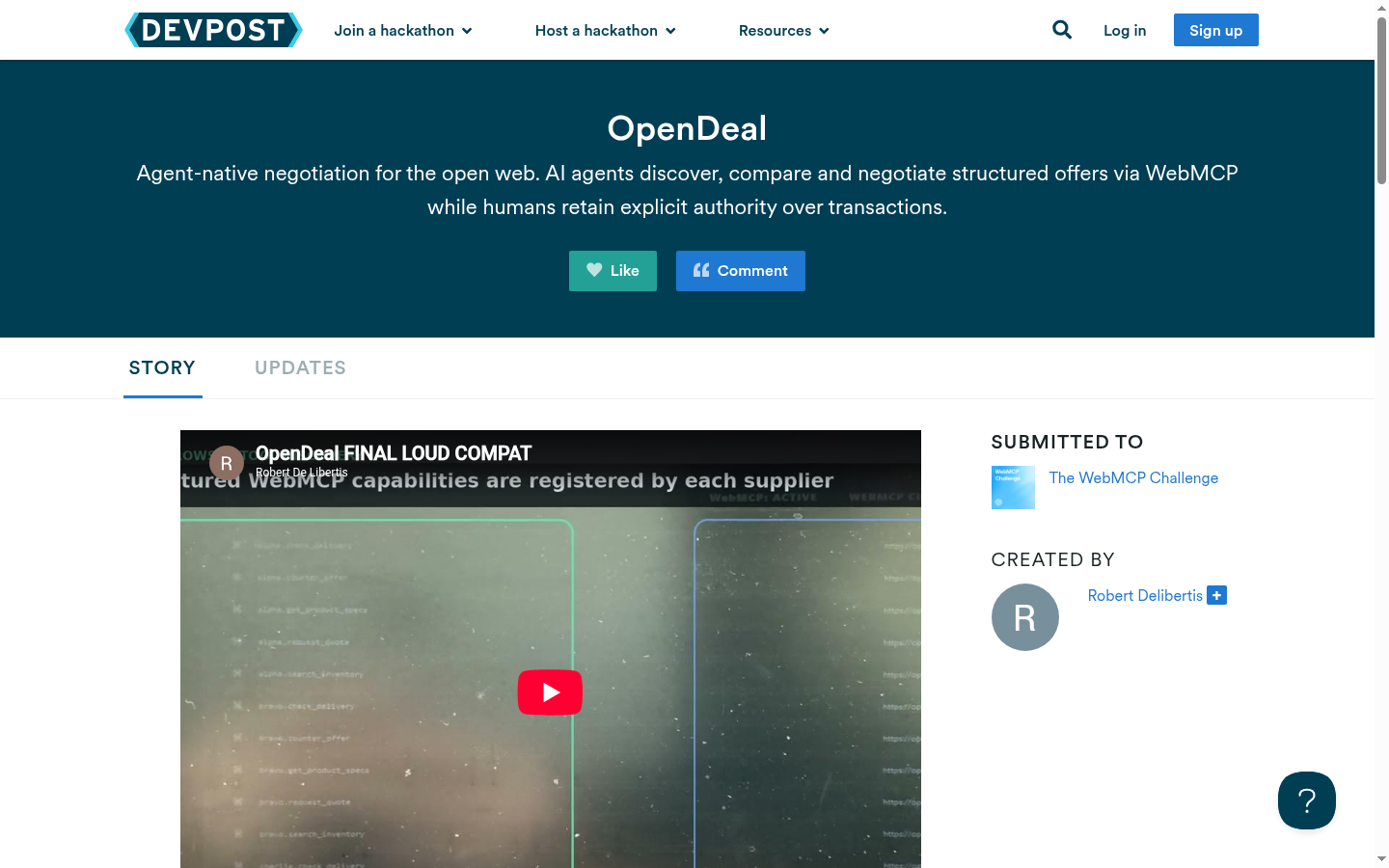
Devpost packaging visibly identifies the negotiation demo.
Impact
8 /10
Procurement with hard constraints and irreversible purchase authority is a credible business use case; the product demonstrates why cheapest is not always compliant.
Evidence cited
Scenario specifies 100 safety helmets, $2,500 cap, Friday delivery, and no substitutions.
Charlie is rejected for missing the deadline despite lower price.
Human approval is required before purchase.
Creativity
9 /10
Dynamic capability lifecycle tied to human intent, combined with multi-party negotiation and post-order capability replacement, is unusually ambitious and memorable.
Evidence cited
Purchase tool literally absent before approval is the product's central thesis.
Frames show Discover→Evaluate→Negotiate→Recommend→Authorize→Execute→Observe.
The design treats authorization as a changing executable surface rather than a cosmetic modal.
03 Review highlights
Standouts across reviewers
Capability lifecycle is a concrete, memorable permission boundary.
Capability absence/presence as authorization enforcement.
Constraint-aware negotiation with irreversible-action boundary.
Red flags
No submitted video/transcript; evidence is description plus contact sheets.
No submitted video and no gallery images.
Frames do not independently verify supplier APIs, order placement, or why Bravo beats cheaper compliant Alpha.
Tool lifecycle claims are self-reported.
04 Evidence
What each artifact proves is labeled on the artifact itself. A Devpost page capture is packaging evidence, not proof the product runs;
video frames are evidence from the submitted demo, not live verification.
Contact sheets from the ?s video the team submitted. This is what reviewers were shown;
it demonstrates the product in motion but is not independent verification.
· watch the original
EX-V1 Sheet 1 of 3 · reported video evidenceEX-V2 Sheet 2 of 3 · reported video evidenceEX-V3 Sheet 3 of 3 · reported video evidence