Origin, access model, eligibility, and substitution are reviewer diagnostics, not judging criteria. Authentication requirements are not penalized.
02 The two blind reviews
Two independent reviewers scored this project blind, from a sanitized evidence packet.
Scores are shown separately so the reasoning stays inspectable. A withheld score means the reviewers differed by more than two points.
Reviewer A (round 1)
confidence 84%
Leverage
9 /10
Typed tools expose operational warehouse state, safety validation, approval gating, routing, and recovery as a shared contract; generic UI automation would be substantially less safe and reliable.
Evidence cited
Description claims seven tools and a deterministic shared state engine.
Frame sheets visibly show an operational command-center interface and mission/status views.
Execution
8 /10
The packet is unusually coherent about a full mission lifecycle and visible command-center states, though the absent video limits observed end-to-end proof.
Evidence cited
Claims a 7/7 ordered flow with completed mission and final metrics.
Frames show consistent warehouse dashboard, mission trace, and status-oriented UI.
Impact
9 /10
Safe, auditable agent control of warehouse vehicles addresses a high-consequence operational need with clear value for warehouse operators.
Evidence cited
Specific pallet, aisle blockage, AGV, routes, approval, and recovery scenario are described.
Safety engine checks destination, occupancy, battery, communication, and traffic reservations.
Creativity
8 /10
Combining WebMCP with a safety-gated physical-AI digital twin and explicit recovery workflow is ambitious and memorable.
Evidence cited
Observable six-stage mission lifecycle includes injected blockage and replanning.
Human approval is structurally required before physical movement.
Reviewer B (round 2)
confidence 74%
Leverage
9 /10
Typed, safety-gated operational tools and shared state are central to reliable agent control of autonomous machines; pixel automation is not comparable.
Safety engine checks occupancy, battery, route, approval, heartbeat, and reservations
Execution
8 /10
The packet presents a complete deterministic twin, ordered flow, fault recovery, and measured trace, though no video was submitted.
Evidence cited
Claims 7/7 tools pass and mission completion
Blocked aisle causes safe stop, replan, and completion; route metrics given
Impact
9 /10
Warehouse safety and operational reliability are high-value needs, and the approval boundary makes the use case credible.
Evidence cited
Pallet mission with AGV selection and human approval
Safe stopping and replanning around blocked aisle
Creativity
8 /10
Ambitious agent-native bridge from browser interface to physical operations with explicit recovery semantics.
Evidence cited
Digital twin and live tool trace
Observable recovery workflow and safety identifiers
03 Review highlights
Standouts across reviewers
Strong safety and recovery framing.
Clear end-to-end operational contract.
Safety-first end-to-end agent control architecture
Red flags
No submitted video; live claims are packaging/description evidence rather than observed execution.
No video; physical integration is simulated/deterministic twin
04 Evidence
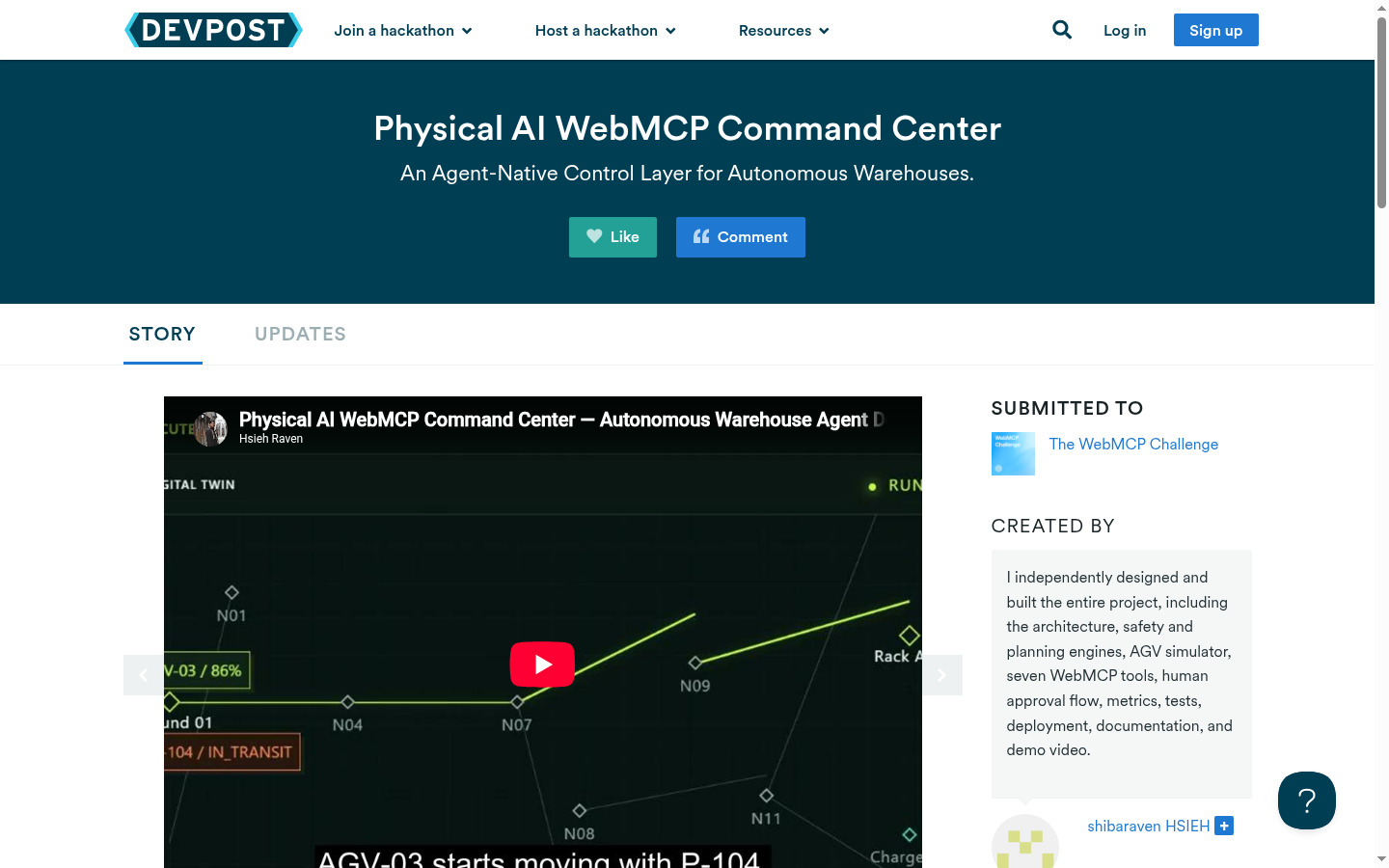
What each artifact proves is labeled on the artifact itself. A Devpost page capture is packaging evidence, not proof the product runs;
video frames are evidence from the submitted demo, not live verification.
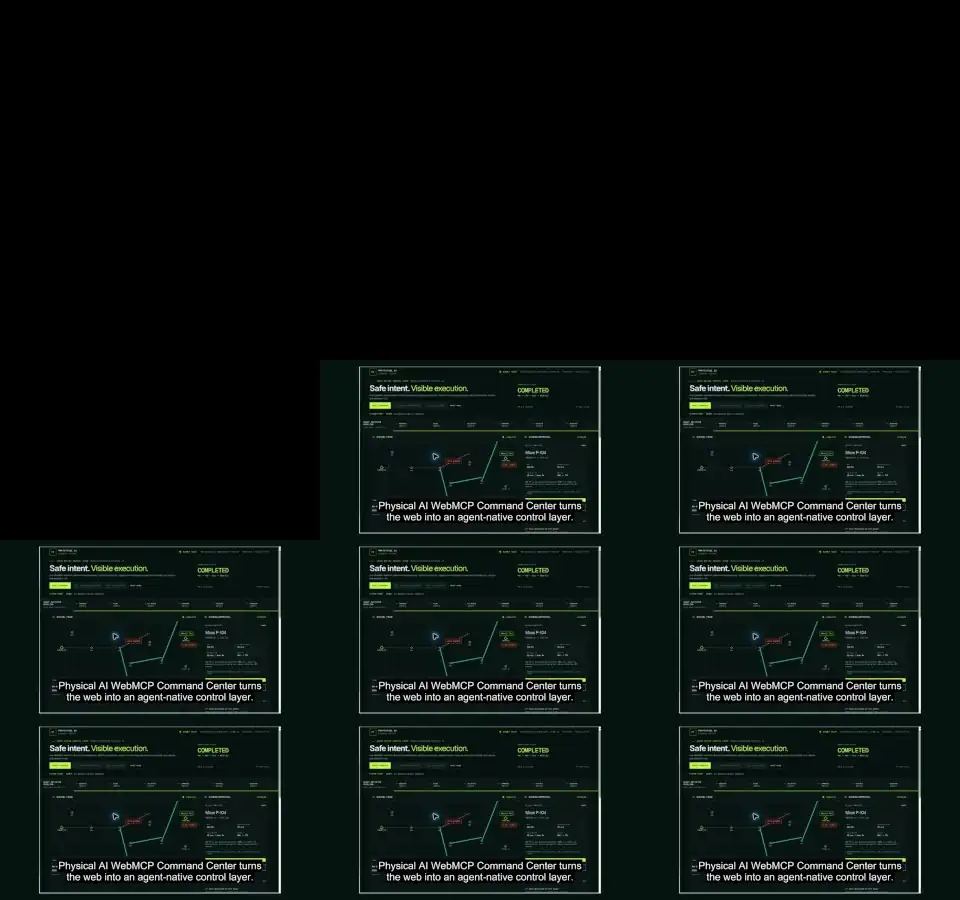
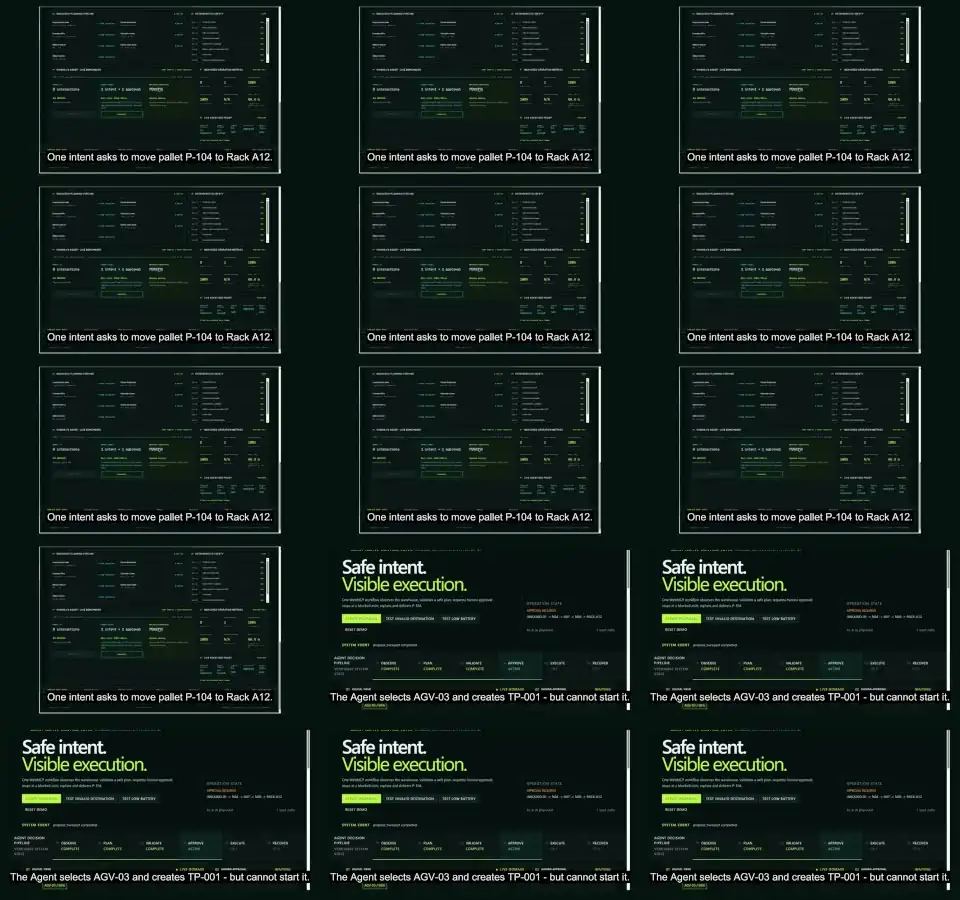
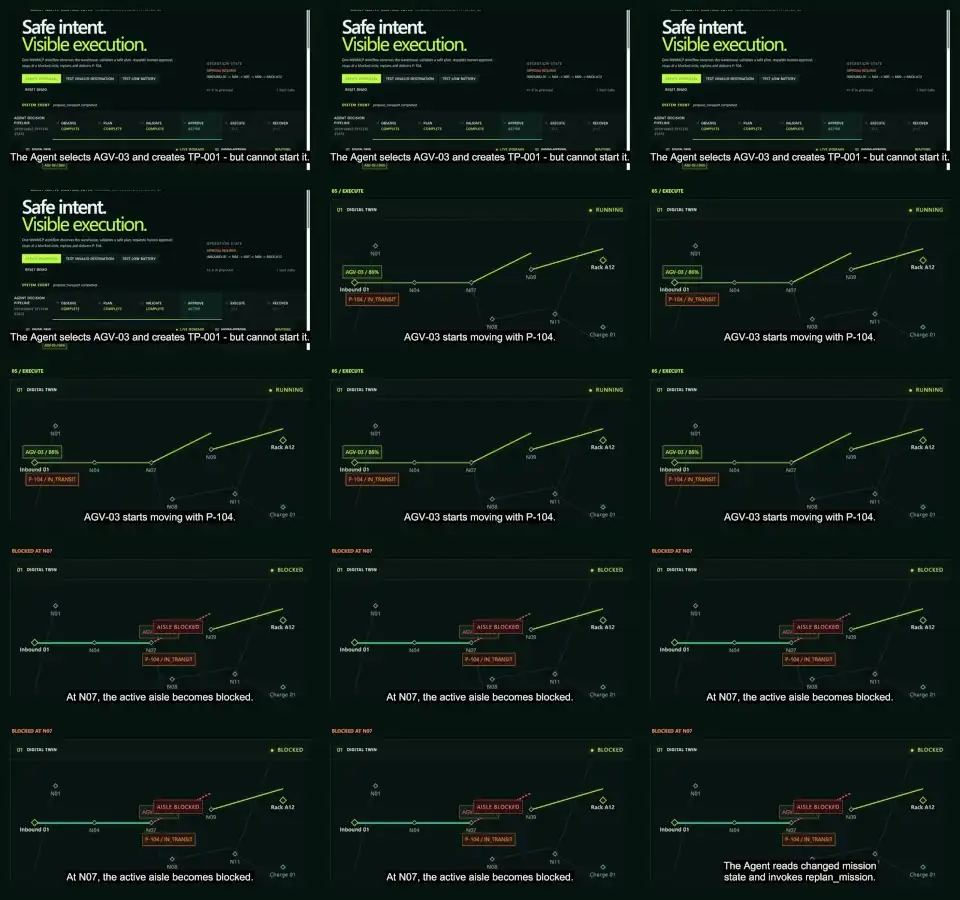
Contact sheets from the ?s video the team submitted. This is what reviewers were shown;
it demonstrates the product in motion but is not independent verification.
· watch the original
EX-V1 Sheet 1 of 3 · reported video evidenceEX-V2 Sheet 2 of 3 · reported video evidenceEX-V3 Sheet 3 of 3 · reported video evidence