Origin, access model, eligibility, and substitution are reviewer diagnostics, not judging criteria. Authentication requirements are not penalized.
02 The two blind reviews
Two independent reviewers scored this project blind, from a sanitized evidence packet.
Scores are shown separately so the reasoning stays inspectable. A withheld score means the reviewers differed by more than two points.
Reviewer A (round 1)
confidence 76%
Leverage
8 /10
Structured agent access to contextual rail state and procedure-grounded actions materially improves precision and shared operator state; generic UI driving would be markedly less reliable.
Evidence cited
Description states agent and operator share a workspace across map, incidents, procedures, and logs.
Each procedure step is approved individually and recorded with a receipt.
Nine incident-type analysis focuses and persistent operational state are explicitly described.
Execution
8 /10
The packet describes a broad but coherent operational workflow with many states and an explicit audit trail; without video, completeness remains claimed rather than observed.
Evidence cited
About text enumerates monitor, inspect, retrieve, approve, log, and report stages.
Facts report live demo and public repository.
No video submitted to demonstrate the central workflow.
Impact
9 /10
Rail control operators face high-stakes multi-source coordination where procedure-grounded decision support and auditable approvals have direct value.
Evidence cited
Description names alarms, train movements, passenger queues, power, staffing, and procedures as coordinated inputs.
Persistent action receipts and operator checks fit operational accountability.
Creativity
8 /10
The project pursues a distinctive shared human-agent control-centre model and adapts WebMCP to a complex, safety-sensitive domain.
Evidence cited
Semantic-zoom network map plus procedure step approvals and end-of-shift report form a deep interaction model.
Reviewer B (round 2)
confidence 78%
Leverage
8 /10
Typed, shared operational state and controlled step approvals make agent assistance materially more reliable than UI driving across many rail data views.
Evidence cited
About text describes shared human-agent workspace and persistent operations log
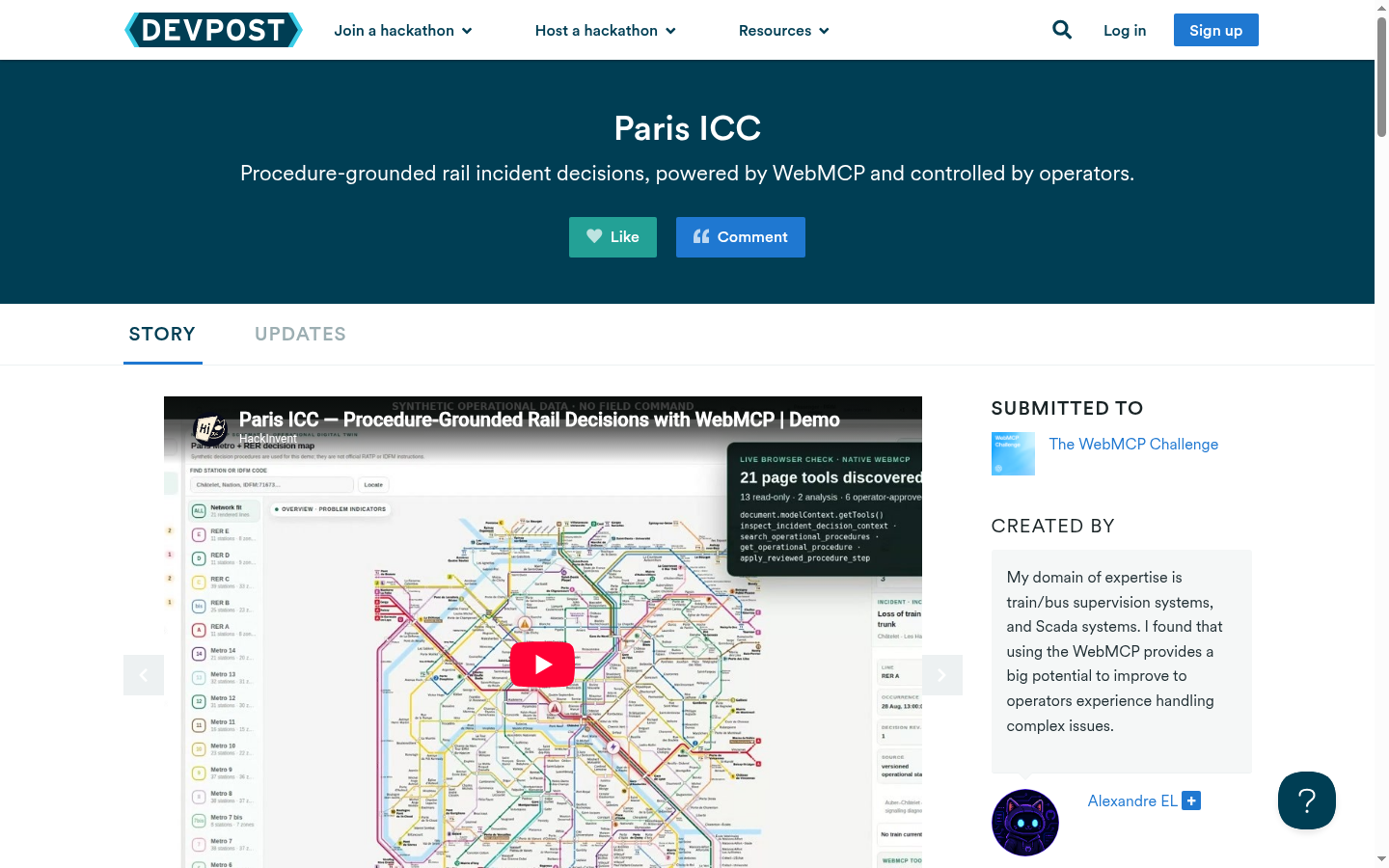
Devpost screenshot visibly brands the demo as native WebMCP over a rail operations UI
Execution
8 /10
The claimed workflow is broad and coherent, with a convincing packaged operations interface, but no submitted video frames are available and the visible screenshot is packaging evidence.
Evidence cited
About text enumerates monitoring, incident ranking, procedure review, approval, logging, and reporting
Devpost screenshot shows a polished rail network operations interface
Impact
9 /10
Rail control operators have a concrete, high-stakes coordination problem; procedure-grounded assistance and human approval directly address it.
Evidence cited
Detailed Paris Metro/RER incident scenario and operator workflow
Claims cover alarms, trains, queues, power, staffing, and procedures
Creativity
8 /10
Applying WebMCP to procedure-bound rail incident operations and operator-controlled approvals is a distinctive, ambitious domain choice.
Evidence cited
Network-wide ICC framing across 21 metro/RER lines
Procedure retrieval plus per-step operator approval and receipts
03 Review highlights
Standouts across reviewers
Strong safety/audit framing for agent-assisted operations.
Specific rail-domain workflow rather than a generic dashboard.
Strong human-in-the-loop safety model for a consequential operational domain
Persistent action receipts and shift-report workflow
Red flags
No video evidence; the extensive workflow is not directly demonstrated in the packet.
No submitted frame sheets despite the packet listing none for video; end-to-end claims rely mainly on written description and packaging screenshot
04 Evidence
What each artifact proves is labeled on the artifact itself. A Devpost page capture is packaging evidence, not proof the product runs;
video frames are evidence from the submitted demo, not live verification.
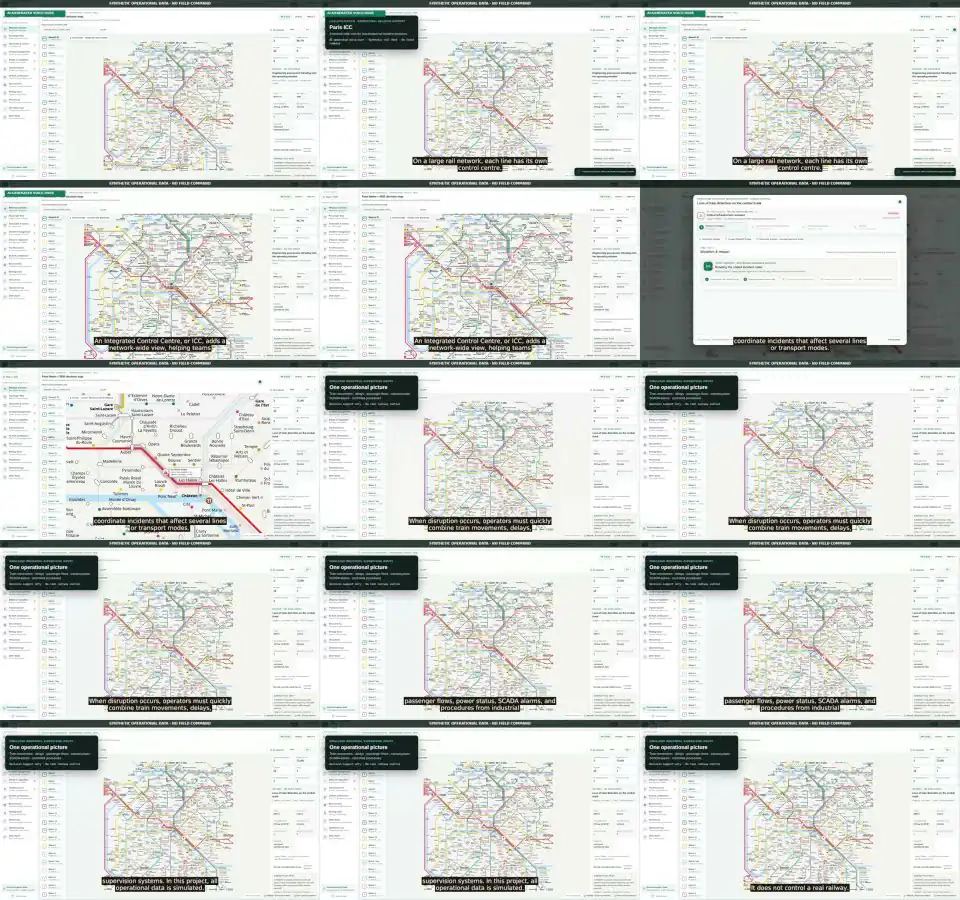
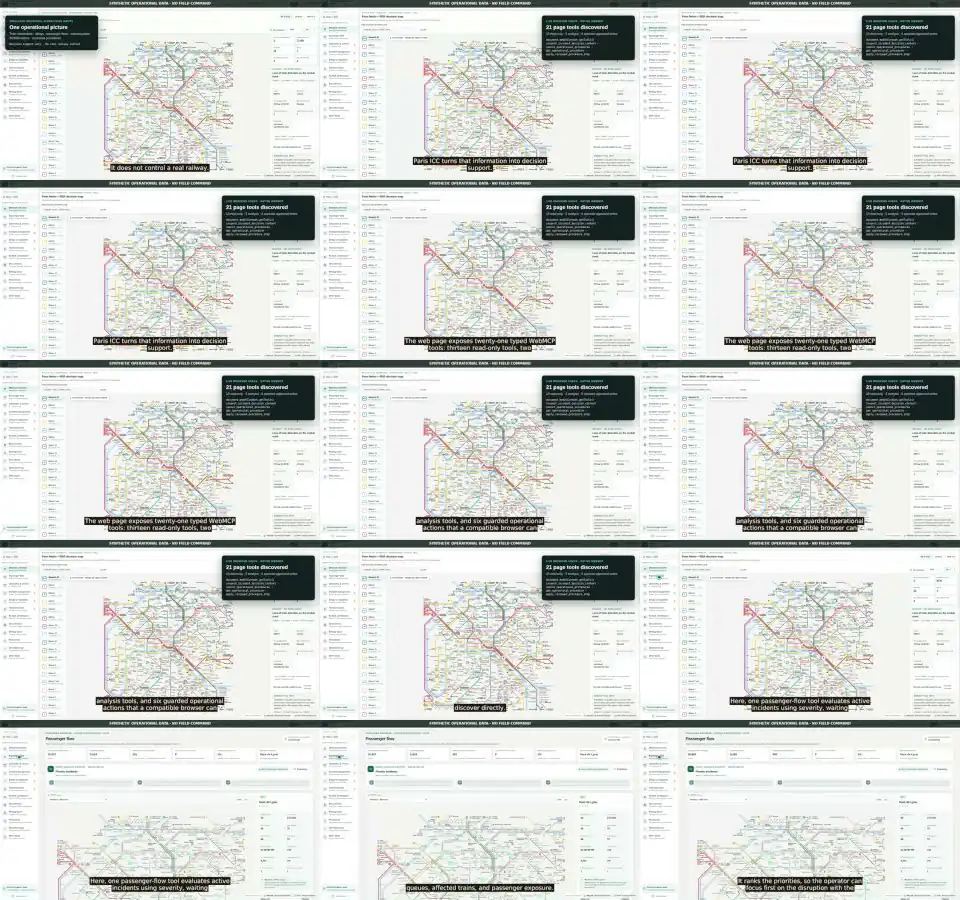
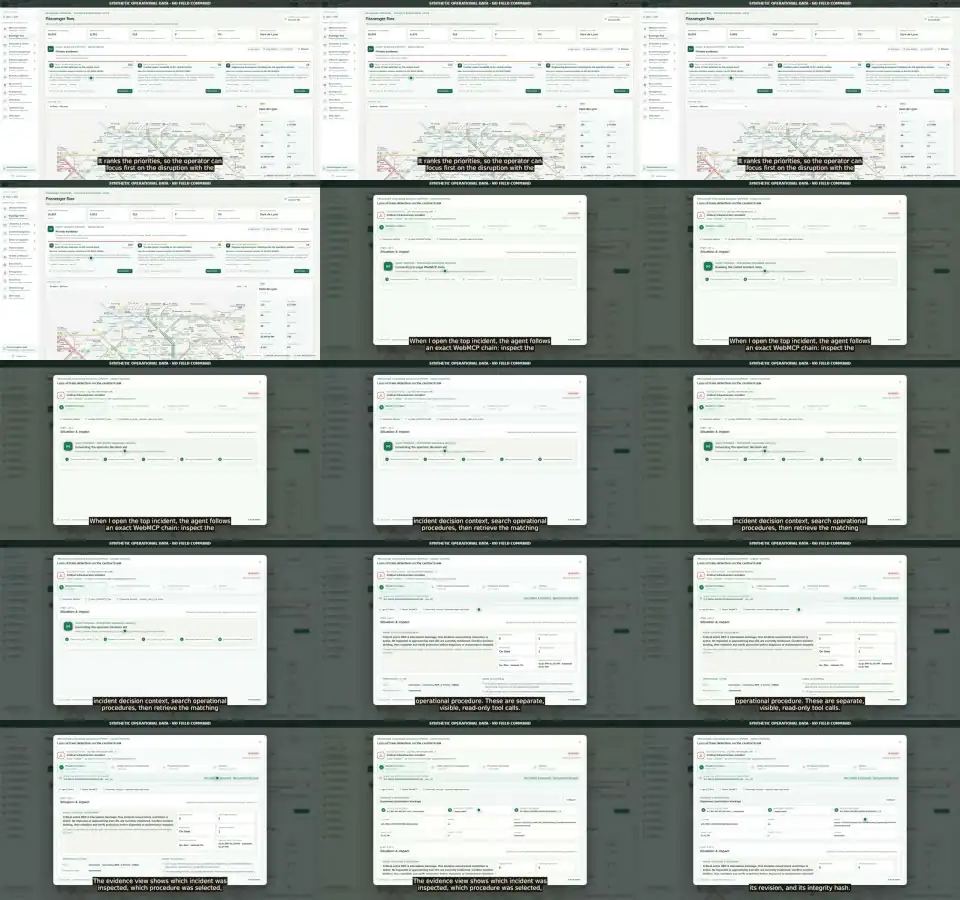
Contact sheets from the ?s video the team submitted. This is what reviewers were shown;
it demonstrates the product in motion but is not independent verification.
· watch the original
EX-V1 Sheet 1 of 3 · reported video evidenceEX-V2 Sheet 2 of 3 · reported video evidenceEX-V3 Sheet 3 of 3 · reported video evidence