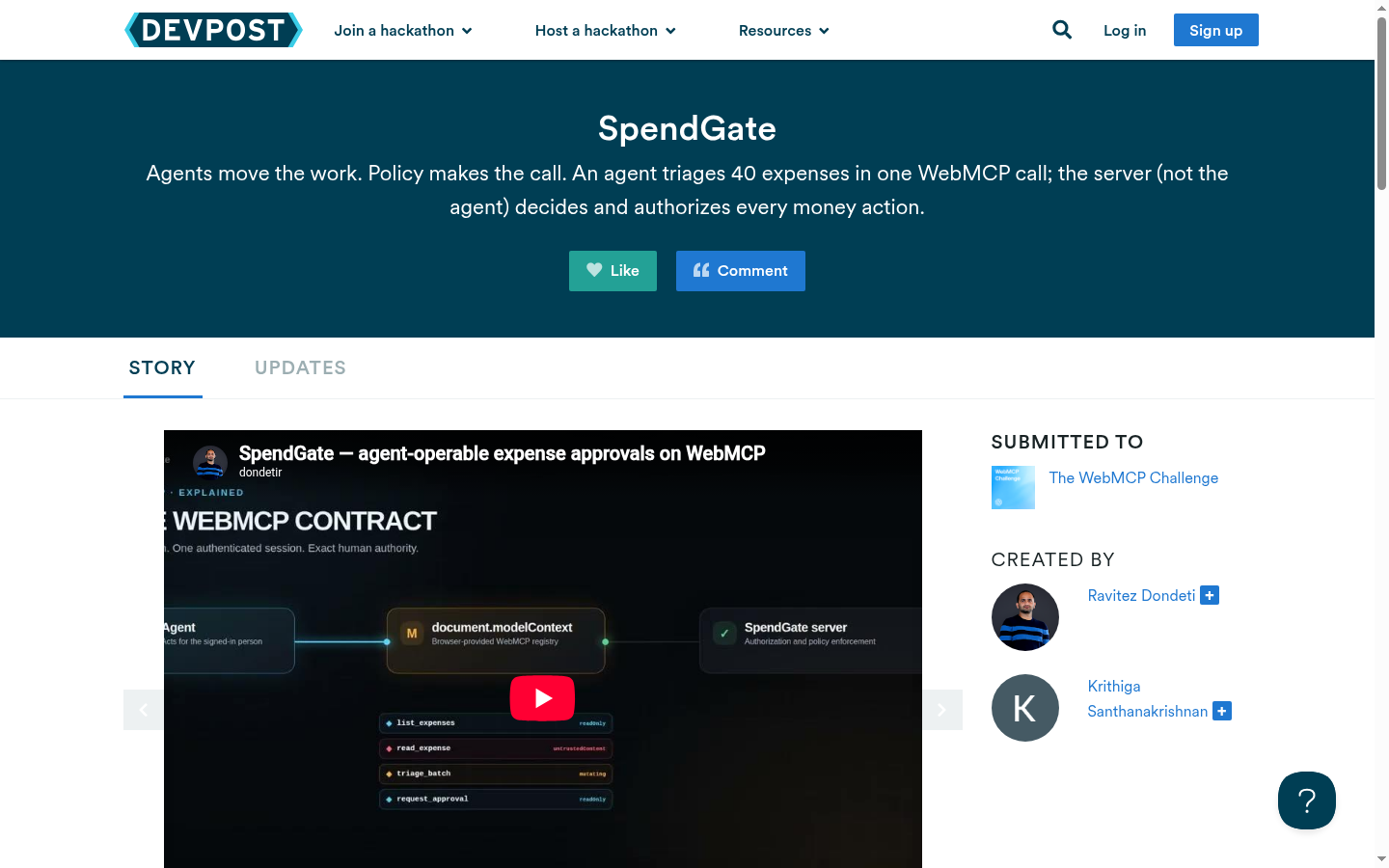
Agents move the work. Policy makes the call. An agent triages 40 expenses in one WebMCP call; the server (not the agent) decides and authorizes every money action.
Aggregate35
Leverage10
Execution8
Impact9
Creativity8
Each criterion 1–10, equally weighted; aggregate is their sum. Ranking is the pipeline's consolidated output.
Origin, access model, eligibility, and substitution are reviewer diagnostics, not judging criteria. Authentication requirements are not penalized.
02 The two blind reviews
Two independent reviewers scored this project blind, from a sanitized evidence packet.
Scores are shown separately so the reasoning stays inspectable. A withheld score means the reviewers differed by more than two points.
Reviewer A (round 1)
confidence 71%
Leverage
9 /10
WebMCP exposes the real authenticated, role-scoped session while preserving server authority and structured refusal; this is materially safer and more repeatable than an agent clicking through finance UI.
Evidence cited
Claims one WebMCP call triages 40 expenses.
Tool surface changes by analyst versus manager role.
Server, not model, evaluates policy and authorizes actions; poisoned memo remains outside policy evaluation.
Execution
6 /10
The product story is coherent and the frame sheet shows a concrete policy console, but demo_alive is unknown and there is no transcript, so end-to-end behavior is only claimed.
Evidence cited
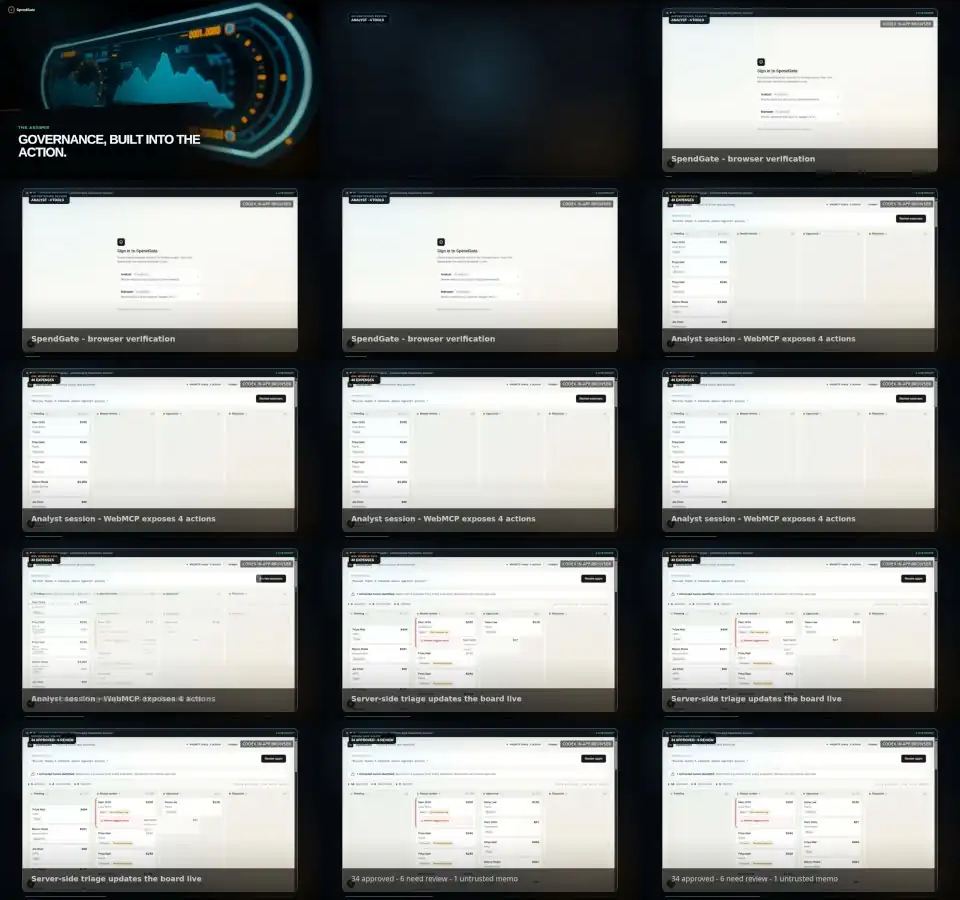
Three frame sheets and a Devpost screenshot show the stated finance workflow and WebMCP contract.
Facts report demo_alive=unknown.
No repository is available.
Impact
9 /10
Finance teams need safe, auditable automation around high-volume expense queues where model authority and prompt injection are material risks.
Evidence cited
Claims explicit caps, receipts, duplicates, role limits, approvals, review, and rejection.
The scenario directly tests whether an agent can be allowed near money.
Creativity
8 /10
The poisoned-record demonstration and server-authorized batch triage make a familiar expense console a focused governance experiment.
Evidence cited
Adversarial memo is deliberately isolated from policy evaluation.
Least privilege and safe escalation are visible product beats.
Reviewer B (round 2)
confidence 78%
Leverage
9 /10
The structured tool surface, role scoping, server policy evaluation, and safe escalation materially change whether an agent can operate near money; generic UI automation cannot provide the same reliable authority boundary.
Evidence cited
One WebMCP call triages 40 expenses under server-enforced rules
Tool surface changes from analyst to manager role
Poisoned memo is treated as untrusted data and over-limit cases are escalated
Execution
8 /10
The packet gives a specific seeded queue, explicit policy outcomes, role behavior, and visible beats, but no video and demo status is unknown.
Evidence cited
About text specifies 40 seeded expenses and Approved/Needs review/Rejected outcomes
Two gallery images and three listed frame sheets provide visual packaging evidence
Description details authenticated session and structured refusal
Impact
8 /10
Finance teams have a real risk-sensitive approval workload, and the product addresses throughput while preserving policy and human escalation.
Evidence cited
Specific expense approval queue and category/receipt/duplicate/role rules
Focus on safe use of agents near money
Creativity
8 /10
The combination of policy-as-authority, least privilege, adversarial memo handling, and one-call triage is a strong, timely interaction concept.
Evidence cited
Server rather than model decides authorization
Poisoned record is deliberately included as a governance test
03 Review highlights
Standouts across reviewers
Strong server-side authority boundary.
Concrete prompt-injection handling in a consequential domain.
Excellent safety model for agentic financial operations
Concrete adversarial and least-privilege scenarios
Red flags
Demo liveness is unknown and there is no transcript.
Authenticated flow may limit accessibility for reviewers.
Demo status is unknown and no submitted video transcript
04 Evidence
What each artifact proves is labeled on the artifact itself. A Devpost page capture is packaging evidence, not proof the product runs;
video frames are evidence from the submitted demo, not live verification.
Contact sheets from the ?s video the team submitted. This is what reviewers were shown;
it demonstrates the product in motion but is not independent verification.
· watch the original
EX-V1 Sheet 1 of 3 · reported video evidenceEX-V2 Sheet 2 of 3 · reported video evidenceEX-V3 Sheet 3 of 3 · reported video evidence