Origin, access model, eligibility, and substitution are reviewer diagnostics, not judging criteria. Authentication requirements are not penalized.
02 The two blind reviews
Two independent reviewers scored this project blind, from a sanitized evidence packet.
Scores are shown separately so the reasoning stays inspectable. A withheld score means the reviewers differed by more than two points.
Reviewer A (round 1)
confidence 72%
Leverage
9 /10
Goal contracts, bounded authority, shared plan state, verified repair, and replayable provenance create a structured agent-human control layer beyond UI automation.
Evidence cited
About text specifies goal contracts, human decision packages, authority envelopes, final approval, evidence receipts, and hash-chained replay.
Frame sheet visibly shows a node/workflow-style application with changing highlighted states, though labels are small.
Execution
7 /10
The architecture and claimed mission lifecycle are coherent and product surfaces are visible, but there is no video transcript or direct end-to-end demonstration.
Evidence cited
Demo is reported alive, public repository exists, and five gallery images are listed.
Frame sheet shows a consistent workflow canvas and state changes including red-highlighted states.
Impact
8 /10
Teams handling consequential operations can benefit from agents that repair within explicit constraints while preserving human control and auditability.
Evidence cited
About text identifies competing cost/time/specification/risk constraints and irreversible commitments.
Evidence receipt and replay address audit needs for high-impact workflows.
Creativity
8 /10
The goal-contract and authority-envelope model is an ambitious, memorable abstraction for safe agent autonomy.
Evidence cited
Packet distinguishes micro-decision autonomy from meaningful human trade-offs.
Hash-chained provenance and plan compression deepen the concept beyond ordinary approval UI.
Reviewer B (round 2)
confidence 72%
Leverage
9 /10
The product's purpose is structured shared human-agent authority, provenance, and replay; these are difficult to reproduce comparably with generic UI driving.
Evidence cited
Description makes goal contracts, authority envelopes, repair, final approval, and evidence receipts central.
Claims hash-chained provenance runs survive refresh and can be replayed.
WebMCP is described as essential rather than incidental.
Execution
7 /10
The architecture and workflow are unusually coherent and complete on paper, but the packet provides no submitted video frames beyond referenced sheets and no readable observed end-to-end proof.
Evidence cited
About text specifies a complete mission lifecycle and interchangeable demo adapters.
Live URL and public code are identified.
No transcript and no directly legible runtime result in available packet evidence.
Impact
8 /10
Bounded authority and auditable repair address a real enterprise problem: useful autonomy without surrendering consequential decisions.
Evidence cited
Targets enterprise operations and product teams with high-impact workflows.
Explicitly reduces micro-approval bottlenecks while preserving final human authority.
Creativity
9 /10
Goal contracts plus compressed human decision packages, bounded repair, and replayable evidence receipts form a novel agent-control interaction model.
Evidence cited
Machine-readable goal contract and authority envelope.
Evidence receipt records disruption, repair, approval, and verified outcome.
Hash-chained replayable provenance is a memorable extension.
03 Review highlights
Standouts across reviewers
Bounded authority envelope for autonomous repair.
Hash-chained evidence receipts and replayable provenance.
Strong authority/provenance model.
Clear separation of exploration, repair, and irreversible commitment.
Red flags
No submitted video or transcript; implementation details and end-to-end behavior remain claimed.
Frame text is too small to verify exact mission states.
What each artifact proves is labeled on the artifact itself. A Devpost page capture is packaging evidence, not proof the product runs;
video frames are evidence from the submitted demo, not live verification.
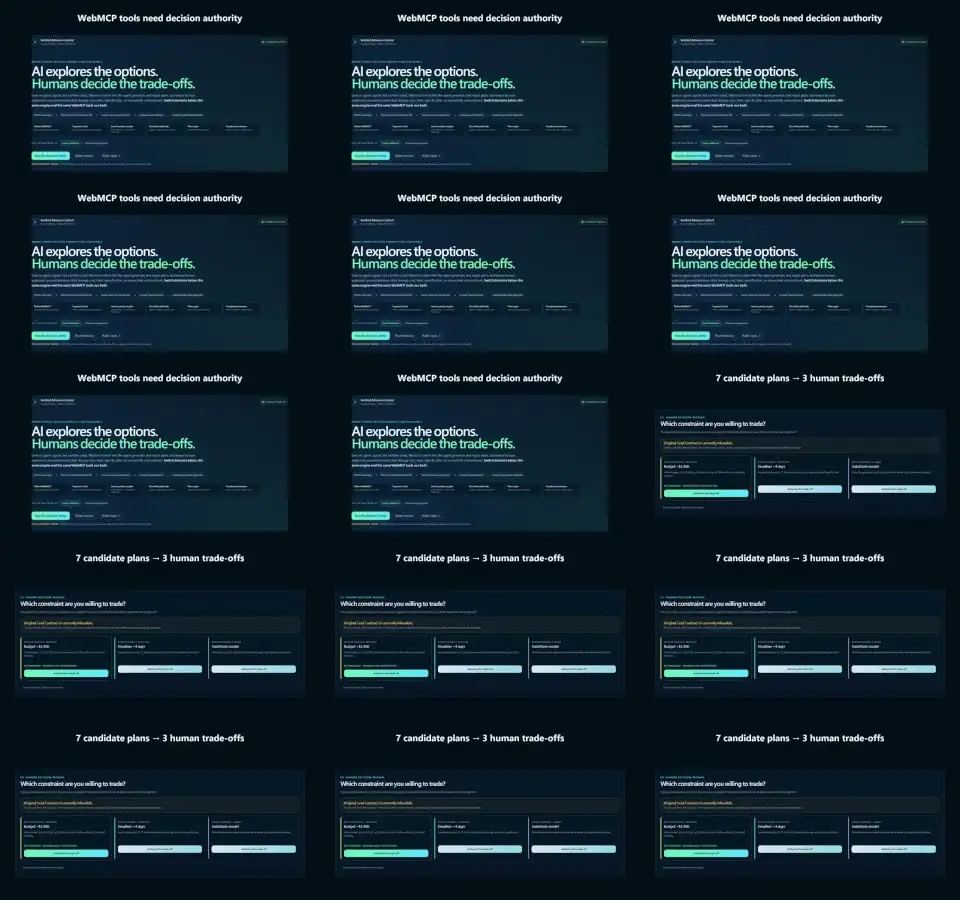
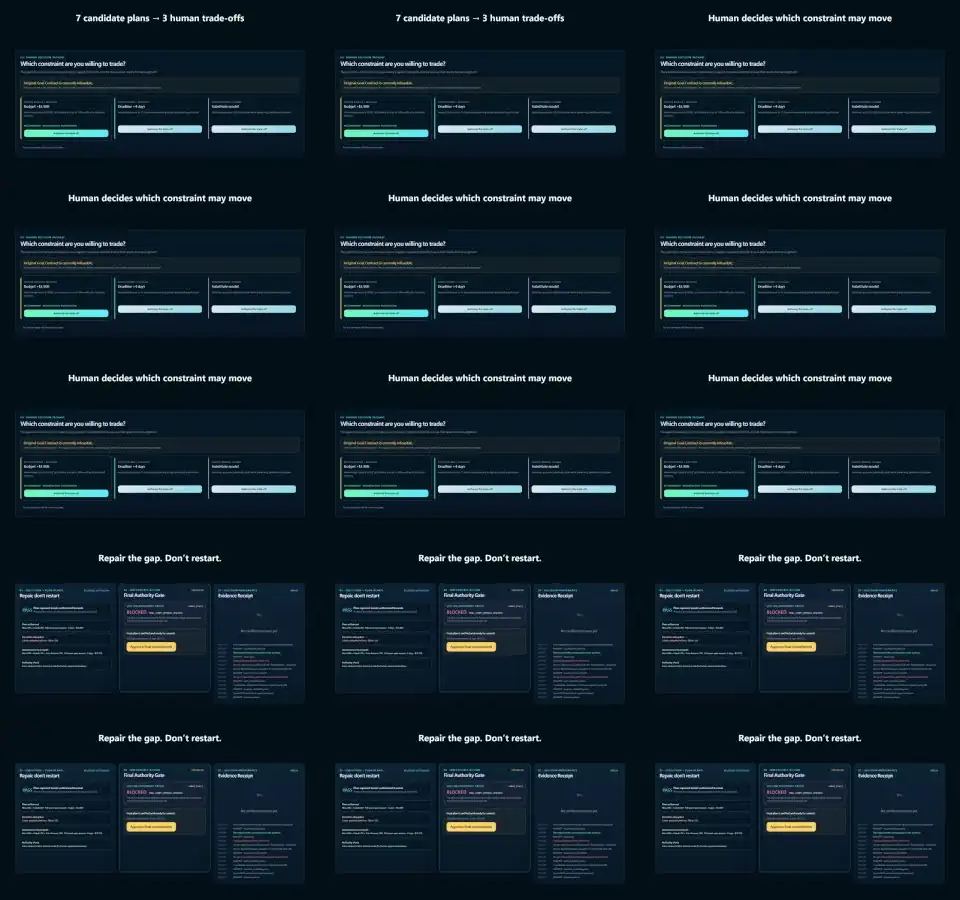
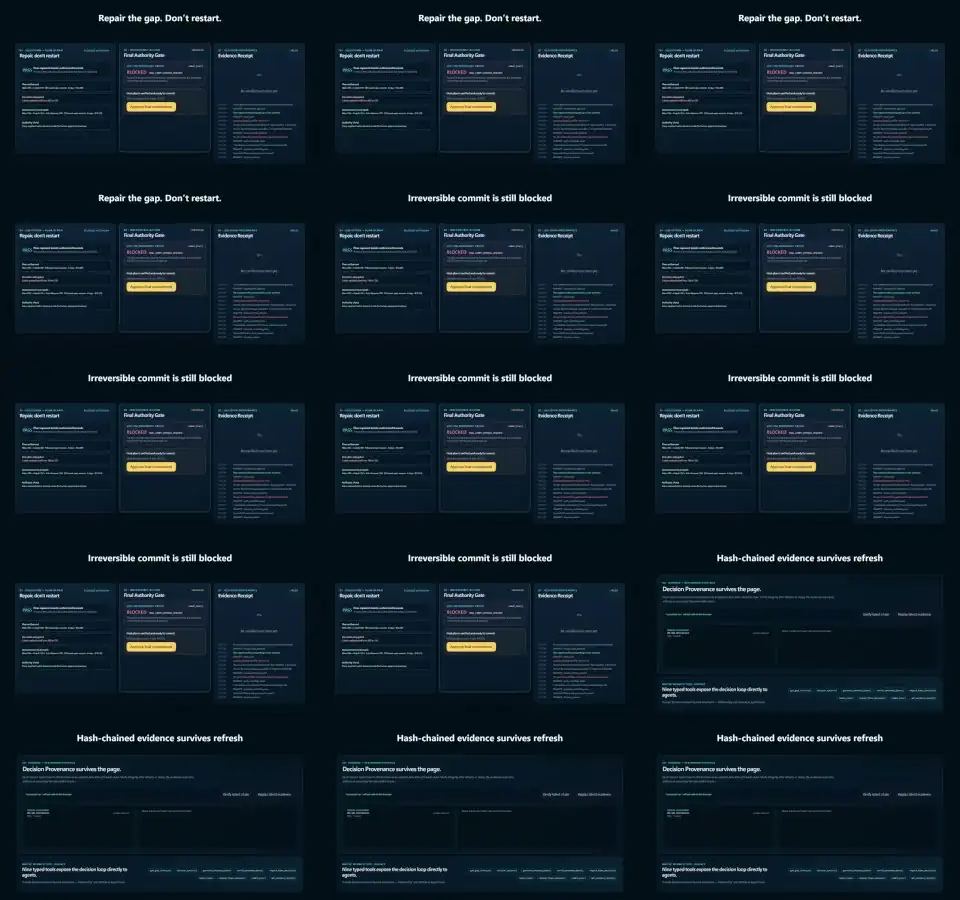
Contact sheets from the ?s video the team submitted. This is what reviewers were shown;
it demonstrates the product in motion but is not independent verification.
· watch the original
EX-V1 Sheet 1 of 3 · reported video evidenceEX-V2 Sheet 2 of 3 · reported video evidenceEX-V3 Sheet 3 of 3 · reported video evidence